



A couple months ago I got to write about a push by Willy Street residents to end peak-hour driving lanes. Peak-hour lanes are an expansion to four lanes (from two) during “rush hour” to try and allow for more vehicles through the Isthmus. Businesses didn’t like it because it took away parking and shoppers received towing fines. Residents didn’t like it because the cars traveled faster in the expanded lanes, making it unsafe. People showed up at Transportation Commission, persuaded City Staff and commission members that a test was needed (critically, at low costs), and they agreed. This was recently featured on Strong Towns and you can read about it below to catch-up. The test ended in October and I owe everyone an update.
Trials are good and we should do more

The peak-lane removal study has officially begun on September 9th
We did the test. It’s complete. And it’s here to stay.
Streets are for community building
There’s a lot of data to digest, but non-drivers felt that Willy Street was more safe or the same after removing the lanes. Based on anecdotal and free response data, City Staff shared that most non-drivers were enthusiastic about improved safety1. 88% of pedestrians felt safety has improved or is the same and 80% support removal of the lanes. Bicyclists were at 92% and 91%. Transit users were at 71% and 59%. For removal, residents on Willy Street supported at 76% and residents within two blocks were at 54% (38% wanted to keep the lanes). Businesses were slightly less enthusiastic (31% remove, 64% keep), but 65% cited no effect on business. These are all huge wins.
To the people claiming Madison is becoming “anti-car”, I’m sorry but I’m going to value safety and comfort on an important local business corridor over the convenience of gaining maybe a minute or two. There will be more discussion below, but Staff noted that travel times didn’t change by much. It was certainly a different feel, as platoons were longer2. Businesses liked that parking was more consistent and Staff compromised on parking spaces near intersections. The Streets Division found it easier to handle trash collection and towing resources were no longer strained as parking restrictions moved to a single block of four hours on Thursdays. Everything described is a win. Some drivers felt “less safe” (probably because they were driving too fast) and I hope they will feel more safe as they adapt to the new conditions. When we make areas safer for residents and shoppers, we see more investment into the community.
Trials uncover misconceptions and bad conventional wisdom
I think it’s important to highlight every time City Staff were surprised by the results of the study. They found:
Capacity was not reduced (expected 14% reduction)
Traffic backups were manageable (expected lines down John Nolen Drive)
Backups occurred mostly Eastbound (expected both East and Westbound)
Weekends didn’t change, overall there were not big differences
City Staff was right about the platoons and they made important adjustments for signal timing to keep traffic flowing. But discovering that the Hairball Intersection was a limiting factor helped encourage at least a “we don’t think this is a bad idea” recommendation. In fact, Staff offered up ideas like bump outs (at non-bus route intersections) and extending the removal of lanes down to Thornton. This approval helped lead Transportation Commission to maintain the removal of the peak-hour lanes (TC 11/5/25).
These discoveries are why we need more tests. If we hold onto assumptions like they are permanent, we will never learn or experience positive outcomes without extensive resources3. We started this study in less than 4 months after the initial crash into the building instead of the initial recommendation of waiting 2 years. We did it for $24,000 instead of hiring a consultant for $100,000-$200,000. We made recommendations despite a failed speed test because the survey results showed overwhelming support from non-drivers for increased safety and comfort. Will this save lives as result? I think so. Even if no one would have been hurt in the next two years on Willy Street, there’s at least $100,000 more available to making another street safer in Madison.
My challenge for Staff and commission members is: what other trials can we perform to potentially make Madison a better place?
Regent Street retains peak-hour lanes
Another local business and residential hub, Regent Street is up for reconstruction. There will be a lot of lobbying and jockeying but Madisonians are already letting the City know that people are more important than cars.
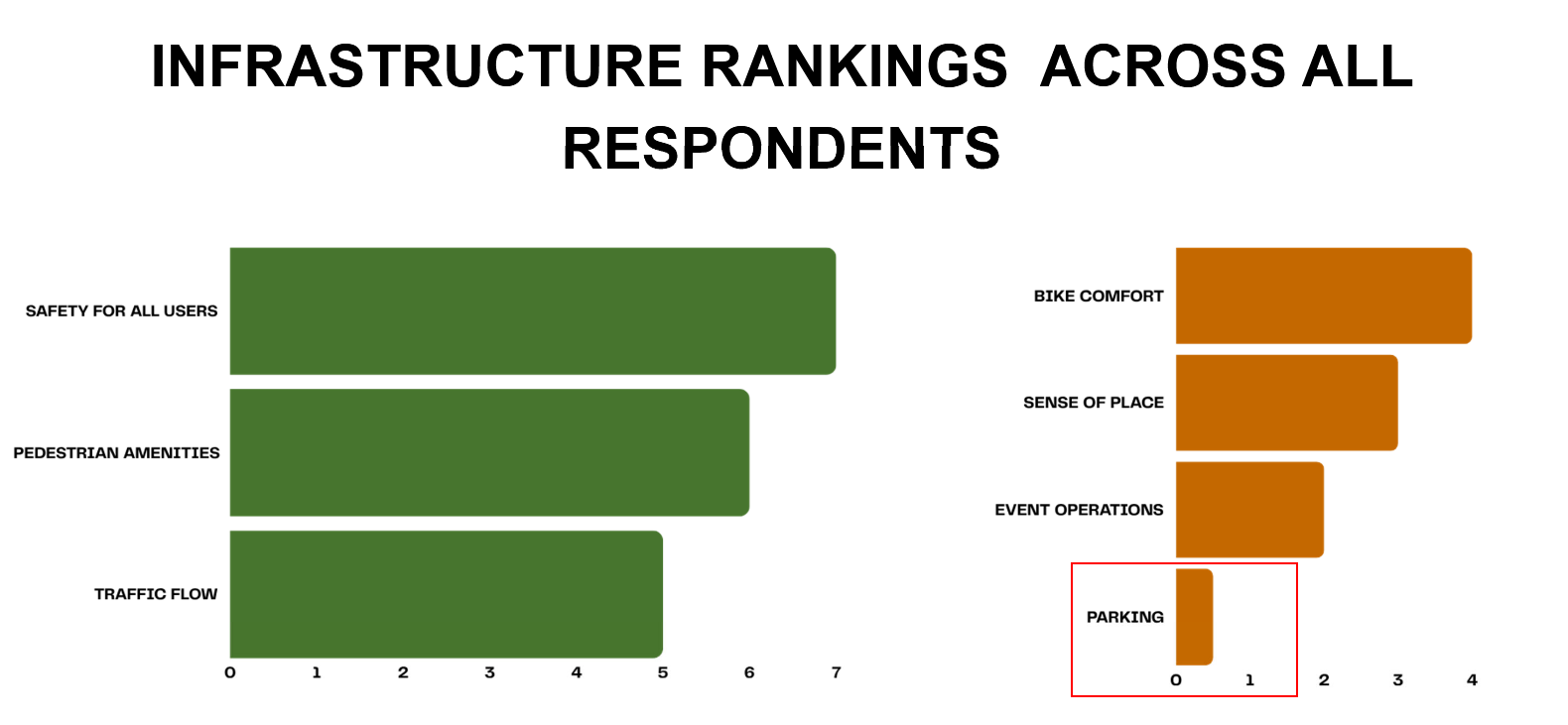
Surveys from initial community meetings show that safety and pedestrians are the top concerns. Parking is not important. They want to make this place meaningful for the students, families, and businesses in the area that make it special. Don’t prioritize the drivers looking for a cut-through or the Badger fans from Janesville that are trying to leave Camp Randall.
I’m sure there will be more to say about Regent Street, but right now we can continue the experiment and remove the peak-hour lanes with construction. If we saw benefits in one area, can we confirm these streets are better off without random expansions?
Parking as an investment vehicle
One of my favorite concepts for a test in Madison revolves around a parking benefit district. Free parking is expensive and these districts turn an asset (popular local businesses or district) into an investment. By charging market rate prices for parking by metering the surrounding area and sending profits right back into district investment, we see:
Faster turnover to allow for more visitors getting convenient parking (increasing visitor satisfaction)
Investment into the area to make the place more attractive to visitors
The investment cycle begins and suddenly you have a fly wheel for public service improvements. Austin invested $1,000,000 into better sidewalks. Pittsburgh got a night patrol.
You might say, “who benefits from increasing parking prices? Aren’t visitors going to riot?” Let me flip the question back to you, who benefits from lower than market pricing? The answer is a couple lucky drivers who found open spots. They are incentivized to stay as long as desired, because it’s a prime location and it’s cheap. It’s worse for everyone else.
If we change this lottery to be supply and demand instead, we see a reduction in employee parking (taking prime spots for businesses), increasing the number of shoppers in the area, increasing revenues for the district, which makes the residents happy. By sending revenues to the district instead of the General Fund, residents buy into the system and accept the unfortunate holiday parking planning for friends and family4.
I anticipate that Willy Street will see an explosion in six-day parkers. Residential parking permits are a “license to hunt”, not a guaranteed spot. Anyone who can get a space will want to stay parked until they need their car or Thursday morning rolls around. Instead, we could make those spots more fluid.
Available parking is a top concern for businesses on Willy. Residents like to experience nice things and have higher property values. We can get both of these by metering. This is technically legal in Wisconsin (although no municipality has done it before, La Crosse was close) and it would be useful to understand if this would help local businesses corridors like Willy, Regent, and Monroe.
Land value taxes might solve this

I can’t help myself, but it would be great to try a land value tax in Wisconsin.
Getting to a Land Value Tax in Wisconsin

I previously wrote about my desire to implement a land value tax (LVT) in Madison. I discussed several vacant or underused lots near Downtown that I think would see rapid development if they were appropriately assessed and taxed.
The City can’t change this, it would require a state amendment based on my analysis, but we could at least value land appropriately. With the Assessor’s values coming out in January, I am hoping to ask how we get to land values in assessments. Often, I feel as if it’s an afterthought to make the price work out on market assessed values. Here’s an example of two lots on the Isthmus that are just around the corner from each other:
They are less than a minute apart, and yet the land per square foot is more than double for the smaller lot.
Here’s the smaller Few St. lot between 2024 and 2025:
I can’t guarantee that there wasn’t a $50,000 kitchen renovation, but it’s odd to me that an aging home (it was built in 1924) saw that large of an increase in value while the land stayed stagnant. I think it would be a significant step forward for the City to assess the land accurately and use the improvements as the residual calculation. It could inform future policy and potentially spur a movement to allow this across the state.
Tests are good, we should do more of them, there’s more to learn
Despite my ambitious ideas for City policy, Willy Street was a clear winner. Not every test will be that; I can guarantee some of them will be duds. But we will always learn something from them.
There’s also a lot of room for smaller tests and improvements; not everything needs to be a news story. I tried to convince City Staff to reduce Prairie Road down to a single lane after a person was killed from a “right on red”. I asked them if we would consider cones for 4 hours, to see if a longer-term temporary test would be feasible, and I was told it wasn’t worth the effort. It’s great seeing this mentality shift towards trials; it started with the W Washington lane reduction near the Southwest Commuter Path and I hope the results from these tests have proven the strength of adaptability.
As resource strapped as we are (staff time, financials), I think it makes sense to pursue the incremental changes over the highly planned, but ultimately, guesswork. It’s understandable for politicians to want flashy objects or staff to want to commit models to permanent rather than temporary infrastructure. But those cost us a lot of time and money. We need to be scrappy. When there are opportunities to change something that isn’t working, like cars crashing into buildings, we should localize it and fix it. If it works, rinse and repeat to other problem areas. If it doesn’t, revert and use the process to inform a different solution. Cities are organic and constantly changing, maintaining a test friendly mindset is how we can make sure we keep up.
If you liked this, you may enjoy…
I hosted a Crash Analysis Studio for Madison

A lot of car crashes are preventable, but here in the U.S we do not take serious efforts to prevent them. Over 40,000 Americans die from car crashes each year. Most of the population knows someone who was seriously injured or died as the result of a car crash. The heartbreaking crashes involve people who had no control over the incident, as pedestrians,…
Madison is pro-people, not anti-car

Sometimes I write at the inspiration of positive stories. For example, I felt inspired by Progress and Poverty’s Uniformity Does Not Preclude Land Value Taxes to look at what the Wisconsin Constitution has to say about LVTs. You can see that here:
The survey questions were certainly framed with “no change” or “failure” in mind. For congestion, you could indicate “too congestion” or “not a significant issue during test”. It was hard to indicate success beyond “nothing changed” unless it was in free text
This may explain frustration for nearby residents who want to turn left at non-signalized intersections, but found no gaps. Their commute became “longer” (but they can always go to a signalized intersection to adapt)
That we don’t have
The top complaint at meetings for neighbors about to lose a spot in Madison is managing friends and family for birthday parties and Thanksgiving/Christmas. We need to think beyond 2 days of the year for the other 363