



Sometimes I write at the inspiration of positive stories. For example, I felt inspired by Progress and Poverty’s Uniformity Does Not Preclude Land Value Taxes to look at what the Wisconsin Constitution has to say about LVTs. You can see that here:
Getting to a Land Value Tax in Wisconsin

I previously wrote about my desire to implement a land value tax (LVT) in Madison. I discussed several vacant or underused lots near Downtown that I think would see rapid development if they were appropriately assessed and taxed.
Many times I’m inspired by negative stories. In particular, I don’t like it when people argue ineffectively for the things that are convenient for them, but difficult for everyone else. I came across a new Tom Still column, the Wisconsin Technology Council’s former president who still has enormous sway relating to Madison and Wisconsin. I’ve read many of his columns and I felt like he was an effective voice for pragmatists. He recently argued that Madison is becoming an “anti-car island” (and that’s bad) in an opinion piece that leans heavily on opinion and fails to persuade me that Madison should be doing anything different (in fact, they should probably be doing more).
We live on an Isthmus
He says it, but still maintains that the John Nolen reconstruction project should have provided more “feasible alternative routes” and complains that a City’s official response to WSJ readers' questions hearkens back to Marie Antoinette’s “let them eat cake”. To be clear, the City said:
Residents are encouraged to make the choices that best fit their situation—whether that means adjusting their route or schedule, changing travel modes or continuing with their current approach ... we do encourage the traveling public to give transit, walking and biking a try to take advantage of those infrastructures, especially when the weather is still good. It won’t work for everyone, but we do know many people who tried it, liked it and sticked with it.
But Tom distilled that into forcing seniors and people with disabilities onto bikes1. Reading between the lines, the readers are frustrated they have to adapt to a changing circumstance like municipal road reconstruction. The problem is 1) roads need to be reconstructed (sometimes at the same time—the same citizens would complain about pot holes if you didn’t fix them) and 2) roads get “scheduled maintenance” in the sense that the City tries to provide ample time for people to understand when maintenance is due, but sometimes you also need to get it done when the Feds tell you to (because grant money).
More importantly, should you be driving a single occupancy vehicle onto the Isthmus and expect no congestion when there are only six streets for those vehicles to travel on? I think Tom and others should be grateful that the Metro system saw a 40% YoY increase in ridership (based on April 2025 data) that can reduce congestion on the main streets. The City saw an opportunity to invest in transit service, significantly increased frequency, and reaped the rewards. The lesson here is that when we invest in alternative transportation, people are more likely to use it. It’s all about making things convenient.

At the same time, Tom and other drivers would like to conveniently go directly from their homes outside of the Capitol to their work/event/restaurant without confronting the externalities of that car-oriented dream. Tom’s problem isn’t with me, a biker/transit user, but instead with everyone other person who wants to drive. To make it so he can drive, whenever is convenient for him, to those areas, without traffic requires extensive expansions of roads and parking. When roads and parking are all your city has, you sprawl and you make it so people don’t want to go there because there are few amenities. That’s what would kill the City. We shouldn’t make sacrifices for thousands of drivers when it would hurt hundreds of thousands of Madisonians.
It doesn’t surprise me that the highest value property per acre is located directly next to the Capitol.
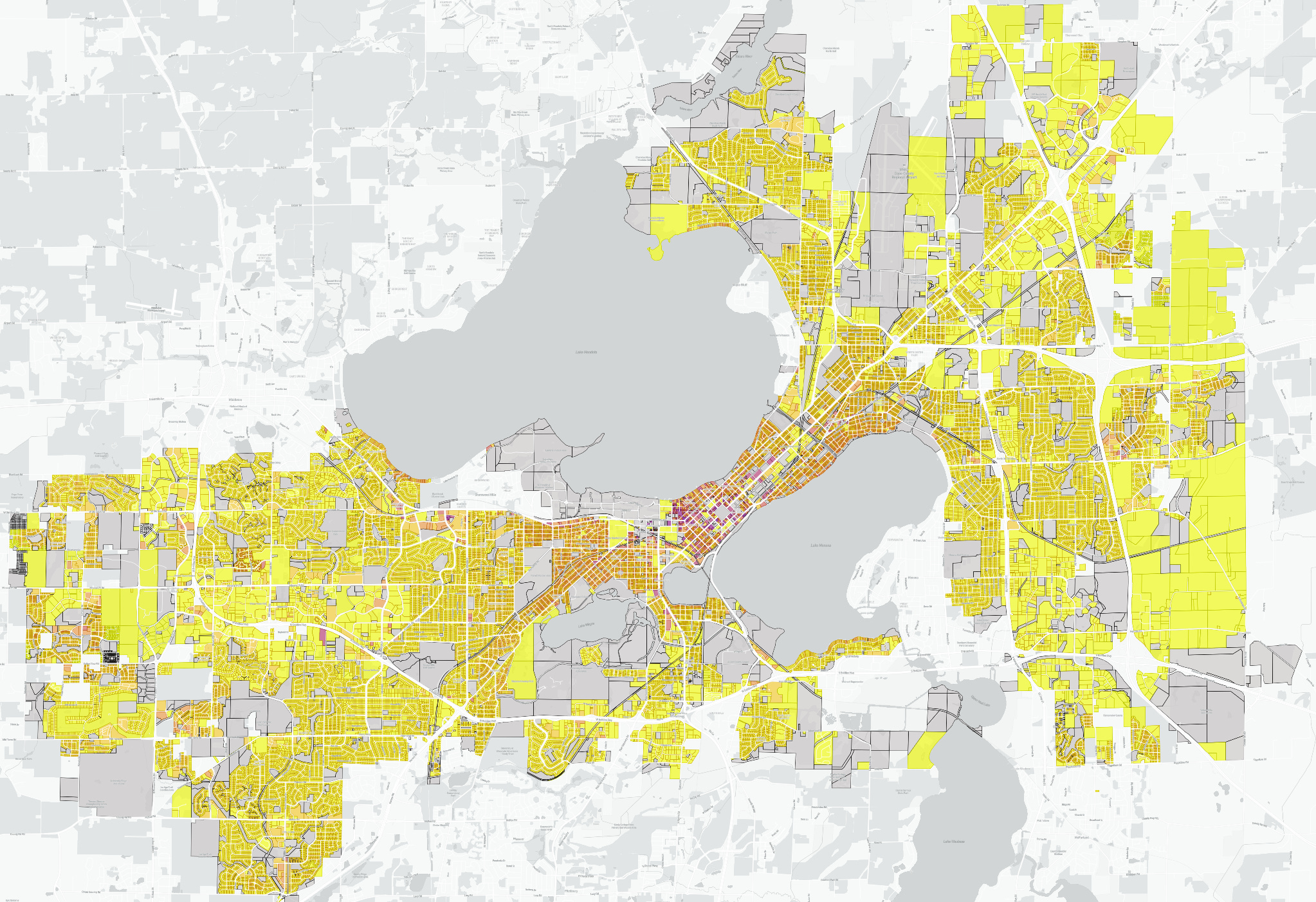
The purple and orange areas indicate higher taxes per acre and that is exactly what the City wants to build. By being close to the City center it is able to build infrastructure at a lower expense and at a larger scale while bringing in more people to help cover those expenses. The community and culture are built here, the places that people want easy access to. It’s the fun districts, the interesting restaurants, the things to do.
A lot of these parcels were developed before car culture (and zoning) were established. It allowed “street-car suburbs” like Jenifer Street to thrive with density that supported transit and business. As the City attempts to bring about more of these housing options, any attempts to slow reform or bring back car-oriented infrastructure precludes these beneficial changes.
I don’t fault him and others for wanting access to it, but they drive from places like the yellow parcels where property taxes are low for the amount of land they consume. By design several decades ago, and by necessity (for the most part) now, the people who live in these areas need to use cars to get places unless they want to brave the elements of the pro-car society2. By simply becoming pro-pedestrian/biker/transit user, and not “anti-car” as he writes, we are trying to make it so everyone can access the City without needing a driver’s license and a steady paycheck. It sounds crazy, but 30-40% of people do not drive in Dane County. He derides the City’s response about alternative commuting, but doesn’t recognize that the “older residents and people with disabilities” may not be able to drive! They might rely on para-transit services or safe intersections to cross to get to the places they need. Don’t even get me started on the freedom for kids to go hangout without needing their parents to drive them. They are a part of the 30-40% too!
We cannot make the City accessible to everyone without frustrating drivers. I think it’s worth the frustration though, because your ten minute longer commute is my more resilient City for hundreds of thousands.
How do we get to a more resilient City?
Still blames the “safety for all” mantra as the main perpetrator for the “anti-car” stance. He states several initiatives the City has taken to make it a safe place to live.
Artificially low speed limits, championed by the “20 is plenty” crowd, don’t work on their own, according to some studies. They especially don’t work with chronic speeders and people intent on breaking the law.
Some traffic lights are not well-timed, which means car and truck traffic must stop at a series of red lights on the same street versus one or two. More idling means more carbon dioxide emissions.
Bad traffic signal timing means drivers blow through yellow lights they consider to be “orange.” They do so to enhance their chances of not getting stacked up at the next signaled intersection.
Speaking of CO2 emissions, how about the flurry of streets with “No Turn on Red” signs, even when there’s plenty of visibility?
Flashing yellow lights at pedestrian crossings enhance safety … except when they remain flashing long after pedestrians or bicyclists have passed.
Express lanes on the Beltline amount to unused capacity most of the day. Just open them 24/7.
Plans to limit access points on Stoughton Road, which is also U.S. Highway 51, might trigger reactions from federal officials who may want to protect a major north-south thoroughfare for truck traffic.
The number of cars hitting awkwardly placed street medians may be on the rise, according to one local leader who had an unfortunate encounter. Kaleem Caire, founder of One City Schools, recently broke his wrist when his car struck an overly wide city median designed for — you guessed it — bicycle safety. He was told by the responding police officer that it was becoming more commonplace.
And here are my refutations about the viability of these safety measures:
Speed is critically important for reducing severe or fatal injuries. Even a reduction of 10 mph (from 30 to 20) can reduce moderate injuries by a third and serious injuries by over half
It’s correct that signs don’t work as well as we’d like them to, but what you are seeing is a compromise between safety advocates like me who’d like to see physical infrastructure to slow drivers down and City Staff who don’t want to be yelled at by drivers who recklessly crashed their car into a median3.
Traffic signaling in one of the busiest areas of the City is herding cats4. Everyone wants to be the fastest out of the Isthmus and that’s exactly the problem. Someone has to be slower. You choose if you want to wait at two intersections for two minutes or one intersection for four. Or bike instead and pass everyone.
Drivers blow through yellow lights and red lights. It’s awful5. It would be great if Madison were included in the Automated Traffic Enforcement bill that might give Milwaukee access to cameras that would incentivize drivers not to run yellow lights. Again, the answer is not “make driving more convenient for single occupant vehicles” at the expense of everyone else’s safety. You set the schedule for your departure and arrival; a yellow light from the City does not entitle you to drive recklessly. Take responsibility and drive safely.
If you would like to read more on the importance of “No Turn on Red” signs in Madison, I’d encourage you to read/watch the following I did in 2024:
I hosted a Crash Analysis Studio for Madison
·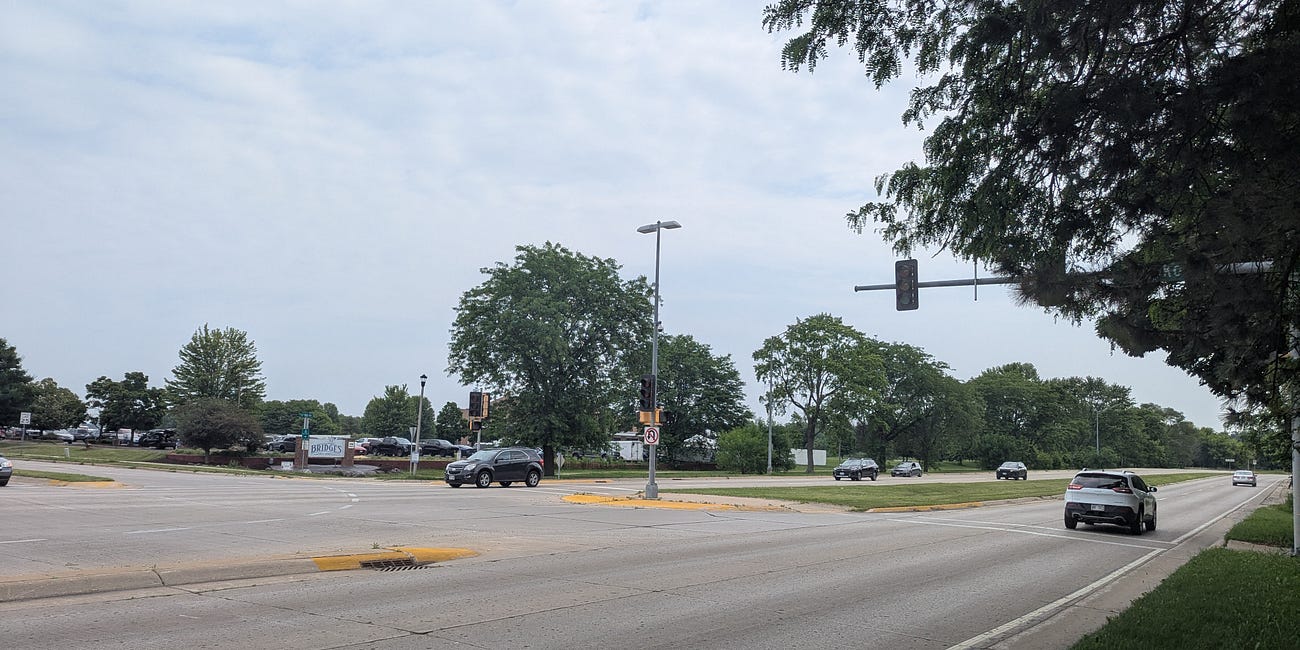
A lot of car crashes are preventable, but here in the U.S we do not take serious efforts to prevent them. Over 40,000 Americans die from car crashes each year. Most of the population knows someone who was seriously injured or died as the result of a car crash. The heartbreaking crashes involve people who had no control over the incident, as pedestrians,…
The level of emissions from idling cars does not outweigh the value of a life. If you care so much about emissions, bike or take the bus/para-transit.
We shouldn’t need Rectangular Rapid Flashing Beacons to cross streets, but see point 1. This is a political issue because cars keep hitting people but drivers get mad when you slow down cars (see point 1).
For highways that are designed to move vehicles at fast speeds with forgiveness, I have no preference. But I will not support expanding the highways for “just one more lane” if congestion increases. The way to reduce congestion is to tax it and we should follow the likes of NYC, Singapore, London, and Stockholm.
I would highly encourage trucks to use I-90/I-94, a larger freeway that can help with truck commerce/traffic. In times where structural budget deficits are really only solved by generating more property value, I do not want to lose more of the far East side to freeway expansion when we could make a new East Washington Ave a few decades from now. Reducing truck commute times by 10 minutes would not outweigh the value of making that area a desirable place to live.
If you hit a median with your vehicle that is designed for bicycle safety, I fear the time where that median wasn’t in place and you hit a biker instead. Going the speed limit is free (of fines and injury) and anyone who breaks a wrist hitting street infrastructure was likely not going the speed limit or otherwise driving safely.

In Tom’s words, “The city of Madison is growing fast, but so are other Dane County communities. Regional planning will become more important as local officials strive to maintain livability for their taxpayers, businesses and visitors. No city, village or town can afford to be an island.”
I completely agree. We cannot afford to waste creating connections via transit and other modes of transportation. If we continue the status quo, we will only sprawl further and become more reliant on inefficient modes of commuting. We will become an island where the time you wait in your car is the toll you pay.
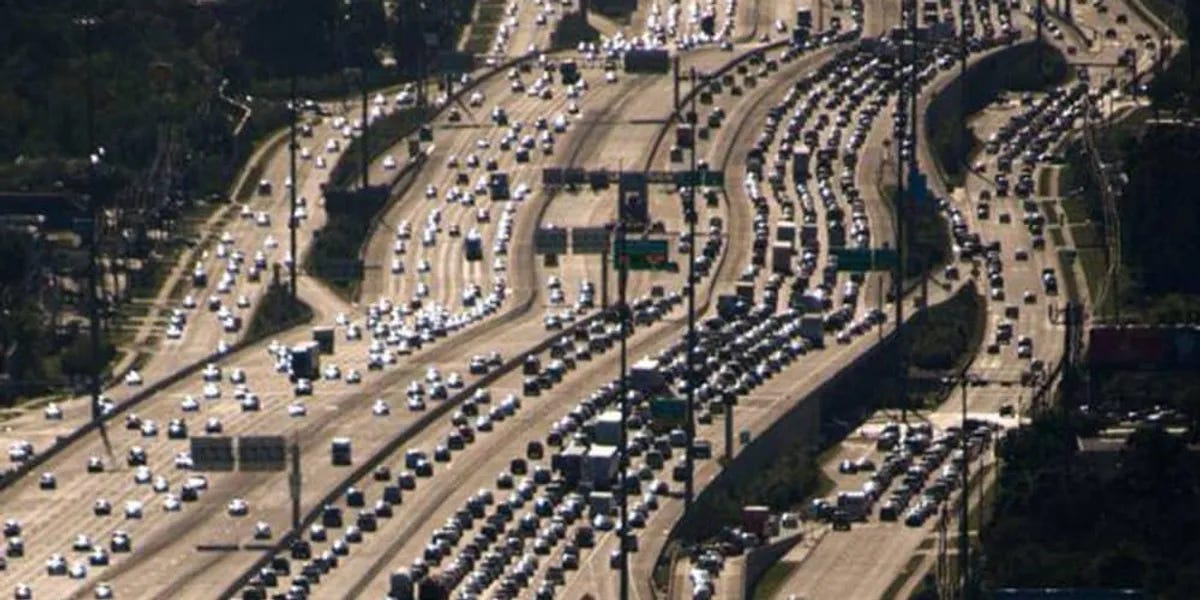
Congestion and traffic are a function of putting more cars on the road. If we want a Madison and Dane County that doesn’t follow every other car-dependent community to freeway and traffic hell, we must do better. And we are, but not if Tom Still has his way.
Skeptical?
I wrote about a trip to Nijmegen in the Netherlands, a city that closely mirrors our own and yet accomplishes so much more in a “pro-people” oriented environment. Give it a read!
What Madison can learn from Nijmegen

I had the pleasure of visiting the city of Nijmegen in the southeast Netherlands for a week in November 2023. As someone who was motivated by Not Just Bikes to start thinking about urban spaces and how people interact with cities, the Netherlands is the mecca for people looking for cultures that aren…
I’m laughing as I proofread that terrible, unintended pun
Winter, sure, but also 30 minute gaps in bus service, bike paths that connect to arterials without safety infrastructure, streets without sidewalks, and communities without grocery stores to name a few
Foreshadowing
Traffic signaling in general is magic and I trust the professional traffic wizards with their current setup. If you are having issues with a light, email traffic@cityofmadison.com
I’ve had too many instances of cars nearly hitting me or pulling people out of traffic because a car is blowing through a pedestrian right of way