


A running joke among urbanist communities is the need for stories, movies, or shows that portray the benefits of building more homes. Far too often, the Hallmark movie features a “greedy, out-of-touch developer” as the villain that learns the folly of their ways and decides not to build the large multifamily building as they fall in love with the person leading the opposition.
While I wouldn’t say we need a YIMBY or Strong Towns blockbuster film, it is nice to have some cultural icon to point to and say “yes, we can have that!”
“That” is a place where communities are connected by physical buildings and infrastructure that serve them and their interests. Not cars, not large corporations or franchises, but the people who make the community.
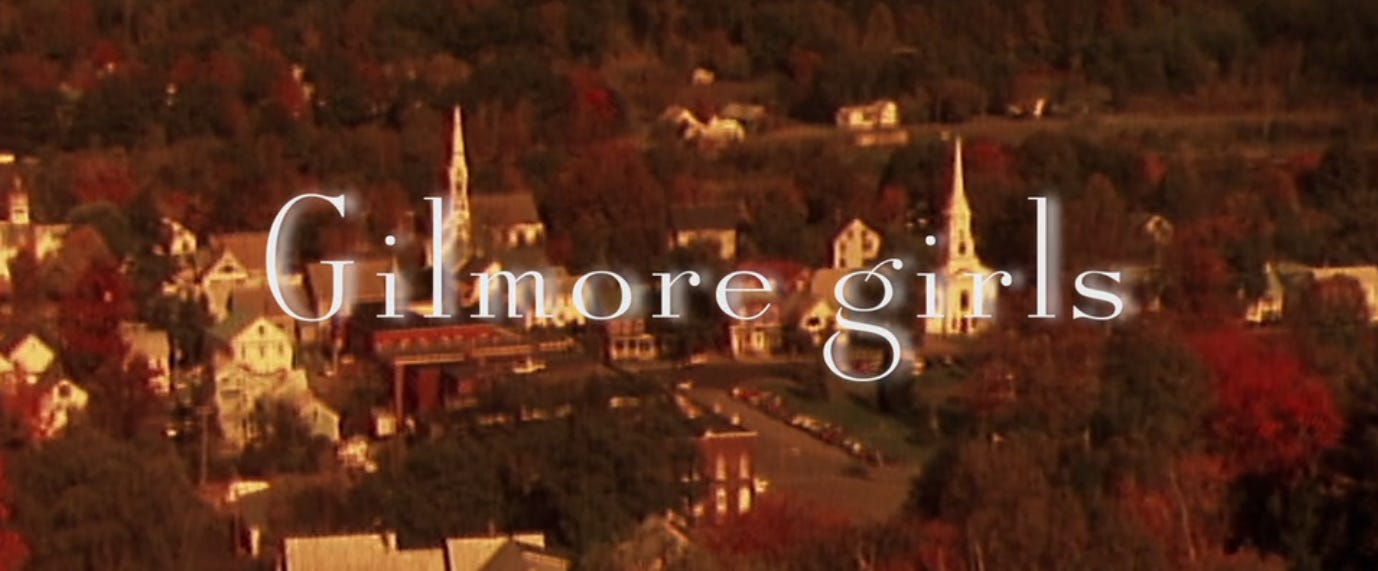
This cultural icon does exist; it was made in 2000 and it’s a story about a mom, her daughter, and their lives in a small northeastern town called Stars Hollow.
Stars Hollow is a Strong Town
I’m not the first person to make this argument, but I found it uncanny when characters in the show would do or say things that I’ve said we should be doing at Madison common council meetings. The town itself is situated as a great example of what an incremental build, pro-walking, local business supporting town can look and function like.
For those who haven’t seen it (I’ve watched less than a full season), the show follows Lorelai and her daughter Rory Gilmore as they work to achieve their life goals in the small town (10,000) Stars Hollow, CT. Lorelai, a wise-cracking coffee addict, runs a local inn and hopes to own one in the future; Rory, an intelligent, book-loving teenager, studies hard in hopes of attending Harvard. The first season is full of moments that demonstrate how forgiving, functional, and fun the town is because of how it’s designed and how the residents make the most of it.


Forgiving: Dean is the new kid who connects with Rory on his first day and shows interest in getting to know her. Rory is transferring from the public school to a private school in Hartford. The new school is 30-40 minutes away by bus. In one of the first scenes post-initial meeting, Dean hops on the bus and chats with Rory. Rory is concerned Dean is going to stay on the bus all the way to Hartford (he has school to attend back in Stars Hollow!), but he informs her that there’s a stop coming up and he’s getting off. This demonstrates:
The bus system is simple enough that a new person can easily understand where it’s going
Stars Hollow is dense enough that bus service to the bigger city is viable
Both are important elements for people-focused communities! Somewhere between 30-40% of the population can’t drive (children, disabled people, seniors) and making sure they can use transit and that it’s easy to use is important.
In another scene, Rory embarrasses herself in front of Dean after saying “thank you” in response to their first kiss. She runs out of the grocery store, into the street, flustered and wanting out of the situation as soon as possible. Thankfully she doesn’t throw herself into a car because the store, while in the downtown, is on a street (and not a stroad). Vehicles are going slow enough that they can react to her and stop. That’s forgiving infrastructure!1


Functional: Stars Hollow allows for Lorelai and Rory to be a single-car family. Rory has ways to get to school if Lorelai is using the car. Lorelai is close enough to her friends and coworkers to get convenient carpooling when needed. The grocery store is downtown, making errands easier. Even in a family where most meals are purchased instead of prepared, it’s not like they are in drive-thru after drive-thru. They go out or pick it up.
One of Lorelai’s favorite things is the first snow of winter. The calm atmosphere and and serene beauty are a must and she (and Rory) always walk around the town, get donuts and coffee, and stand out at midnight to listen to the snowstorm. When snow starts to fall she’s in the downtown area (it’s really close!) and IT IS calm. What’s missing for most Americans is the constant crunching of snow under car tires. When people crave quiet, it’s not the homes or people that are the root of the problem. It’s the never ending noise from the cars. The snow also remains beautiful because it’s not covered in black exhaust and tire particles on the side of the road.
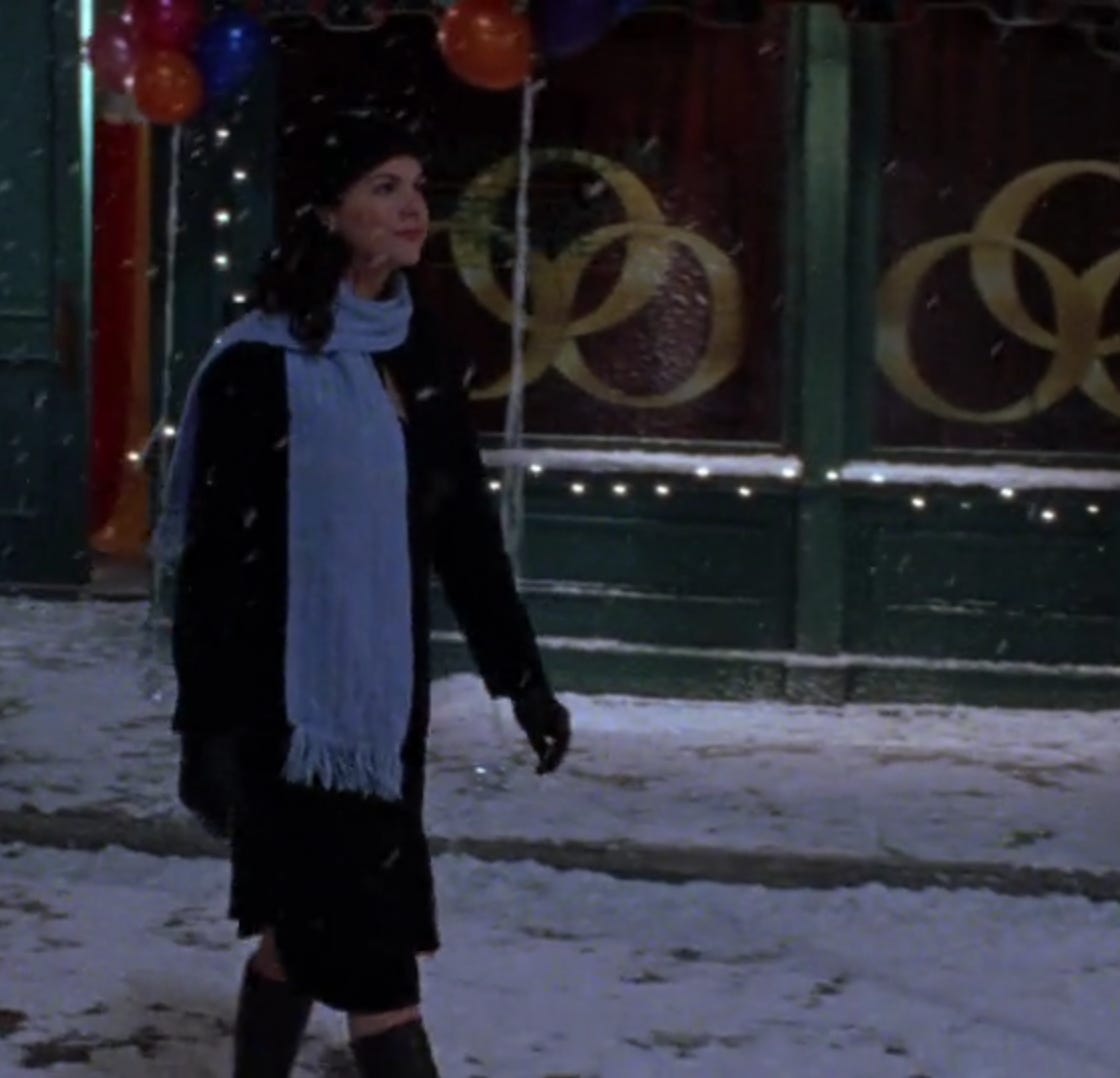
Fun: Stars Hollow is full of chance encounters. The center plaza serves as a third place and community meeting area. We see pet adoption events, rummage sales, Christmas tree lightings, and Revolutionary War reenactments. In one instance Rory, often lost in books, forgets that she’s supposed to meet with her friend Lane. Lane finds her, apologizing that she thought they were meeting at Luke’s and misremembering. But she didn’t! Rory’s just lucky enough that she enjoys being in the plaza and she’s probably going to run into her friends by being at the center of the town.


Our cities and towns aren’t as forgiving, functional, or fun as Stars Hollow. Some get one of these aspects if they are lucky. At the heart of our infrastructure is an overreliance and deference to the convenience of cars. But it hurts our communities when we self-select into more harmful, inconvenient, and isolating areas.
A lot of people tune into Gilmore girls in the fall, based on the autumn and cozy aesthetic the show displays. When people crave this piece of Americana from the past, I hope they will see that we could have this ourselves. It doesn’t need to be nostalgia. We just need to be real about what it would take. You might not get a parking space within a minute of arriving at your destination, you may have to deal with some traffic, and won’t have every store or item at your fingertips at the lowest price. But you will have a strong community and reasons to be a part of that community. You should try listening to the main characters of the show!
Characters advocate for the pro-people vision
The moment I realized Gilmore girls thematically aligned with the “pro-people” groups was in this scene with Lorelai. A local business owner is bringing up creating more free parking spaces in front of his business at a Town Hall. This immediately makes me smirk, thinking about the wasted opportunity of non-metered parking spots. And Lorelai makes the same face I did with the explicit argument!


Opens on a Star Hollow Town Hall meeting. Lorelai walks in with snacks and drinks
Lorelai: “What did I miss?”
Rory: “Taylor Doose wants the no-parking zone in front of his store removed. He says his customers are being unfairly ticketed.”
Lorelai: “No, it’s just because he wants to park there all day.”
She’s exactly right! After making this connection, I stopped passively making observations and paid attention. How many times had Lorelai or Rory advocated for better communities? Here are some examples:


Lorelai: “It’s a sad highway”; Rory: “as compared to all the happy highways?”
Luke has a no-cell phone policy
Lorelai gets a street occupancy permit for a rummage sale in less than a month?2
Lorelai helps Luke repaint his diner, with avid support from the local business committee
And while I’m only halfway through Season 1, there seems to be something in every episode that I agree with or admire. Not only is the town a gem because of its infrastructure, but the characters recognize how it’s special and they contribute to and help maintain the magic that we observe.
It’s not an in-your-face advocacy. It’s the kind of small quips that I think speak to emotional arguments often used against making cities and towns more people-focused. Lorelai doesn’t need an urban planning degree or to be coordinating a petition to persuade the audience this is a town you want to live in. It’s the nudges, comments, and aesthetics that speak towards the value Stars Hollow has that make it memorable.
Gilmore girls has staying power and cultural resonance
And we should make it an example of the best people-oriented cities and towns have to offer. The most important aspect of the show as a lodestar for positive media portrayals of people-centric communities is its impressive run on Netflix. It seems to go back into the Top 10 each fall and it’s been that way for at least a decade. Many people desire to live like the Gilmores. And we can! We just need to point out how Stars Hollow becomes the desirable town. It’s people living near the downtown core and being able to support its local businesses without owning multiple cars. It’s providing options like walking or taking the bus that are convenient for everyone. Streets are calm. There are places where people meet consistently without scheduling it in advance.
If you give Gilmore girls a watch, keep an eye out for these elements. And if you ever go to a meeting or talk to someone where they challenge an improvement and say “why would we want this change?” you can point to Stars Hollow as an example of what we could have.
More from Counting Cranes
Madison is pro-people, not anti-car

Tom Still (former Wisconsin Tech Council president) says Madison is becoming too "anti-car" and may close itself off as an island. I argue it's the cars themselves that are making us an island, we should continue to invest in people-centric infrastructure (and do something different than every other city).
More trials! (I'm looking at you Regent Street)

A successful Willy Street lane closure experiment shows the importance of doing smart, low cost trials to help keep people safe on faster timelines. Here are some more trials I hope Madison will consider.
There could be more traffic calming that physically slows vehicles down, there seems to be an understood slower speed for cars that doesn’t match the design of the street
I don’t have confirmation on the amount of time, but Lorelai “had the idea, helped organize, and volunteered to run”. The Gilmores are always busy and my guess is it didn’t take constant back-and-forth with the town to get a permit
Love this kind of analysis using pop culture to look at real world issues. Even though I don’t watch the show, fun stuff.