


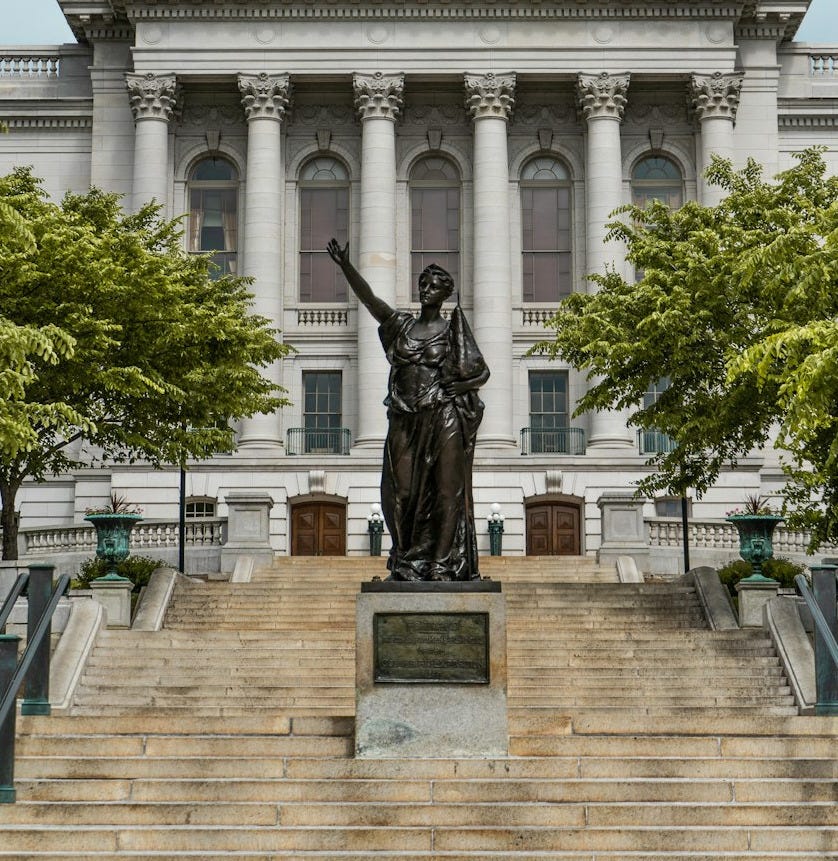
I pitched Isthmus on an opinion piece for Regent Street. My side lost handily in a unanimous approval of the presented and preferred street design. Timing didn’t work out, but 800 words is a tight limit and I have thoughts about what should be done next. You can find the original pitch here:
Madison Unanimously Fails Vision Zero

I pitched Isthmus on an opinion piece for the Regent Street vote. We lost the vote, but it’s still important for people to know what Common Council voted on and why. As we move further away from the decision, we lose context. I still stand by my work so I’m posting it here.
I wrote from the perspective of a teacher who assigns a failing grade on a student’s assignment. The rubric that I’m interpreting and the rubric that Common Council uses to make decisions are the same, but we clearly don’t see the same picture.
I don’t blame the alders for their vote. I understand where the priorities of some communities lie and I acknowledge this is an improvement on the existing area. Objectively, the design could have been safer and objectively they had the prerogative to ask city staff for a safer design. They decided it wasn’t worth it; the compromise that had been formed over months of public surveys, meetings, and commissions gave them a reasonable design that should be approved. I am not an elected official and I don’t have to defend my votes to constituents. It’s easy for me to dream when I’m not on the roll call.
At the same time, I don’t want this to happen again. The flexibility that Complete Green Streets provides for street design is great for staff, commissioners, and alders who understand what outcome they want. The problem is that it is not clear to the public when guidance can be prioritized or dismissed, making objectives murky when we are in the weeds of street geometries but clear when they are announced over press statements.
I have a couple ideas on where we should go from here, ranging from bad to good, and I hope this addendum to my original opinion piece can provide a map and the start of dialogue for providing clarity to the public.
My worst idea: End Vision Zero
My opinion piece focuses on the Vision Zero goal of eliminating traffic fatalities and injuries. Madison clearly has invested into this concept; a Vision Zero Progress Report was in my inbox the morning after the vote. I think we can all agree that people not dying is good public policy. Some cities have gotten close to achieving this, too! It’s not impossible, it just takes a lot of work.
The Regent Street vote showed that there’s a risk tolerance on Common Council, and presumably the public who voted them in, indicating that Vision Zero level work wouldn’t be justified by the City’s other priorities. Safety is good, but not paramount, and therefore we should still prioritize other goals (vehicle congestion, parking, etc.) over reducing safety risks to Vision Zero levels. I still think that most voters prefer alders to vote for safety over convenience, but maybe there’s a spectrum and it’s safety first when it can be completed quietly, on streets that receive less public push back.
If this is the case, maybe we should consider dropping Vision Zero goals? If we can tolerate some risk for safety, that implies we aren’t trying to get to zero deaths or injuries. We are trying to get to *minimal*, but not entirely zero.
This would help provide clarity by showing speakers, like myself, that we aren’t going to prioritize safety in every scenario. Sometimes, level of service is important on a community main street. I can give public comment saying level of service only really matters on highways1, but Common Council can justifiably say “thank you for your comment, but we need to find the best compromise for everyone.” I can advocate for candidates who would prioritize safety, and understand that if that candidate loses, it’s not what the public wants, and I need to go back to persuading people.
My personality at times can be analytical, and this is an analytical answer. It’s not a politician’s answer, which is why this is the worst idea2. “Your alder wants people to die in the streets” is a justified campaign motto during an election if they revoke Vision Zero. Do I think it would be good if we didn’t play Three-Card Monte on when Vision Zero matters? Yes. But that ship sailed when it was voted on by Council.
My better idea: Support Standards with Data
There are three glaring weaknesses with the passed Regent design:
14’ lanes (12’ in ‘feel’ if you read the FAQ) that were requested by Police and Fire for emergency vehicle access despite having no standard or ordinance supporting lanes this wide
A “reflecting phase” of the Complete Green Streets guide that adds “on streets with small, local businesses (Main Streets in the street typology; see Section 5), the
importance of on-street parking is well-recognized and is a high priority” that usurps the existing modal hierarchy
The use of overlays to stray away from standard designs of streets of this size (resulting in more turn lanes and smaller curb radii)
There are more, but these are the ones I wanted Common Council to ask questions about and to get staff to provide answers. I hope when I reach out to discuss these opinions that we can have productive conversations about strengthening the data and positions behind them.
For the 14’ lanes, it would be helpful for the Police and Fire Departments to provide data on emergency vehicle access. The hospitals providing comment would also help. The kinds of questions I would like to ask include:
Which transportation modes cause the most delays for police and fire vehicles?
Which streets are known to be congested? Do police and fire strategically avoid these streets?
Are certain vehicles within police and fire fleet more susceptible to being delayed?
What situations call for larger fleet vehicles? Has the department’s strategy of vehicle deployment changed over the years as the departments confront new challenges?
When do emergency vehicles need to access different trauma level centers? What’s the base case for an emergency vehicle needing to access Level IV trauma while using their lights?
What is the foundation of needing 14’ lanes (and 28’ clearance) when traveling in an emergency? Is this a Wisconsin standard? A national standard?
I would ask staff and local businesses for the parking considerations:
Is parking a priority in survey data of just businesses? Or do the surveys include customers and nearby residents?
Have we performed a financial analysis3 of the value of on-street parking for Community Main Streets? Is there objective data that can support the need for on-street parking?
“Loading zones, if needed, should be provided around the corner on intersecting minor streets” did not end up in the final draft. Instead, loading zones are on Regent Street4. When can we deviate from guidance if there isn’t a clear overlay providing a variance?
Should UberEats/DoorDash be a major concern for Community Main Streets?
When the Community Main Street section states “parking may be a higher priority”, when is the may a must, as it seemed like it was with Regent? Is it the number of businesses?
And for overlays:
Do specific overlays have priority over others? For example, when there are transit overlays that state designs should prioritize in-lane stops and truck overlays that cite the need for smaller curb radii, what causes one to be in the plan and the other to not be?
How many “Community Main Streets” in Madison would take the standard design parameters without a variance? If the answer is zero, why aren’t the overlays part of the standard design parameters?
How many “Community Main Streets” in Madison are “not common” and require center turn lanes?
A range of 10,000-25,000 average daily trips is a large range. Should we split the “Community Main Streets” into separate concepts?
When does NACTO come into play?
We want clarity
The Saturday before the vote I spoke to a room of a few dozen people describing how we might want to approach public comment. We all saw the flaws in the design, but we expected that the status quo was good enough to get support.
I told the room that I was seeking clarity. We were late to the process, joining in on meetings in January when discussions were already solidifying ideas in November. There were even private groups that had been planning their ideal street design for nearly a decade. The best we could hope for was a clear vision on the objectives Common Council sought. With a win, we could move more urgently with trials and small improvements to the network, just as we did with Willy Street. If we lost, more persuading would need to be done on the importance of safety.
What’s clear to me is that Complete Green Streets is a subjective document. My arguments that I made that Tuesday are backed up by the same document that staff used to defend their design. This is a discrepancy. Standards should not have discrepancies. Flexibility helps staff in some areas, but in this case it’s not flexibility with efficiency but flexibility with control. I would really prefer to know in advance whether my argument is meaningful or if it can be swatted away with ease. I don’t think this was directed at me, but some alders implied that citizens were calling staff liars or swindlers5. I don’t believe that, I read the FAQ and I understand where they can justify their design.
An analogous movement currently underway by Madison City Staff is rezoning “Planned Development” zoned parcels. These PD zones were popular a few decades ago because “it gave alders, neighborhood stakeholders, and developers a tool to better control development details.” They are being removed because it adds more work on staff to identify the variances, applies to specific parcels rather than general areas, and reduces transparency. It would be great for these two silos to intersect and compare notes on PD zoning and CGS designs.
I don’t think the Regent Street design prioritizes the right goals. And I think a legal design exists that does. Help me understand why we shouldn’t prioritize my goals for safety so I don’t have to stay up for hours resigned to defeat. With clarity, I can walk away knowing that it was the standard design and we didn’t leave options on the table.
More from Counting Cranes
Is Madison a Vision Zero City?

*Update: Common Council unanimously voted for the preferred design option. You can see my initial thoughts here: Common Council Rejects a Safer Regent
Trials are good and we should do more

The peak-lane removal study has officially begun on September 9th
And even then, the answer shouldn’t be “build more/wider lanes” but to tax the congestion!
It’s also why I think I could never be a politician, some of the ideas I have are just too important to me to consider compromise
I wish I could perform a sales tax analysis like Darrell Owens did in Berkeley, alas there’s not public tax data available at street level. It’s also state and county sales taxes, not a city sales tax
This, despite local business owners indicating a preference for side street loading zones during public comment
I believe the word I used was “loop-hole” which implies an incorrect usage of something but still remaining in the legal bounds of use
You’re a builder, Josh ! I love how you are striving to get to yes with compromises