


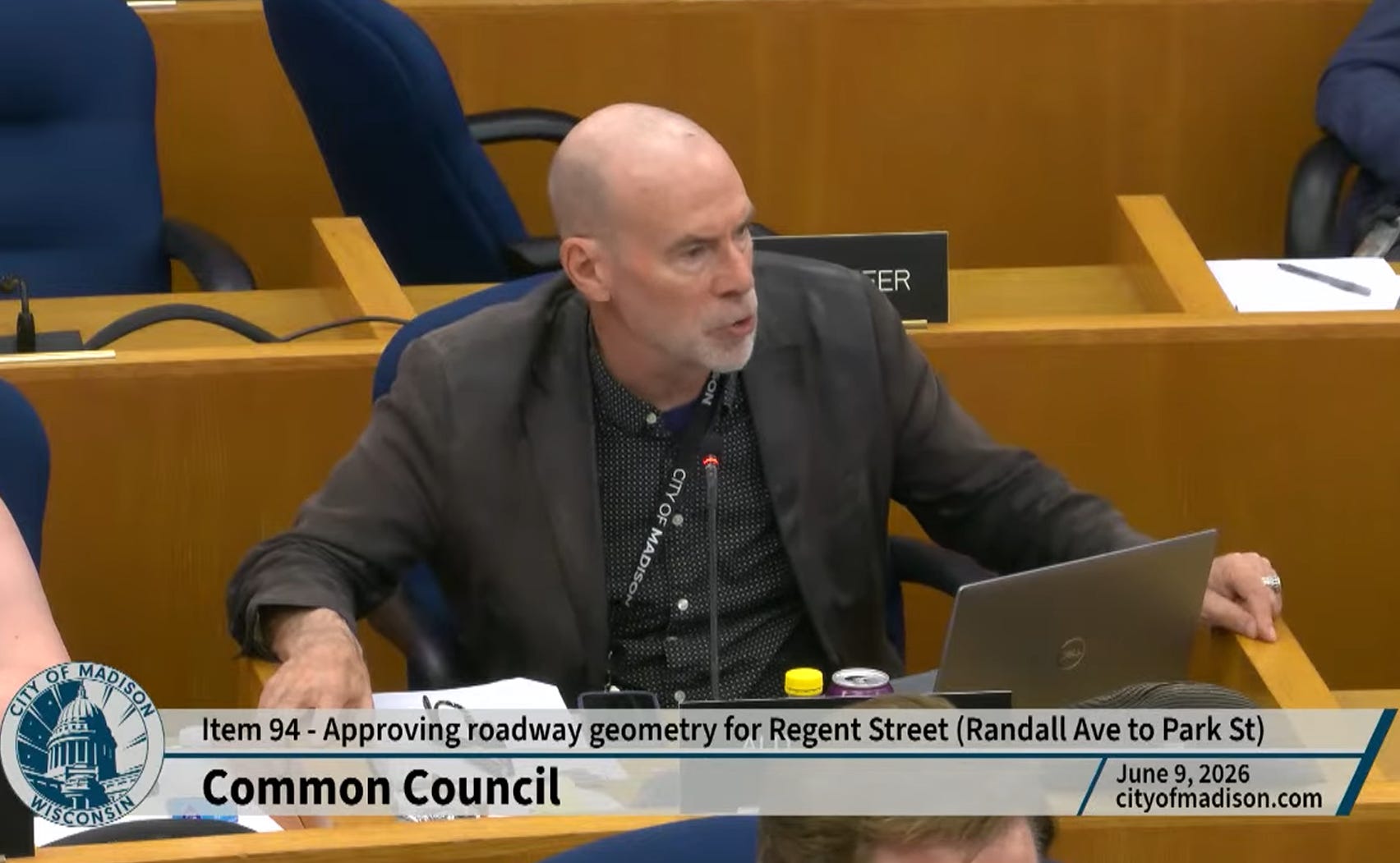
Hi,
My name is Josh Olson, I'm a former resident of the Regent Street area. As a student, I never considered walking on Regent because the cars were erratic and the sidewalks were too narrow.
This design is an improvement on what exists now, but it has more potential. That potential is outlined in multiple planning documents and guidelines: Complete Green Streets, Vision Zero, NACTO, and All Ages and Abilities. We could achieve this potential now if City Staff designed the street like the guides suggest we should. Staff went a different route, which is why I'm here tonight.
I'm also a Strong Towns member, where we think streets should be safe and productive. That means narrow, open for business, and prioritizing people more than cars. The founder of Strong Towns recently noted that staff do not make decisions, they advise elected officials on the consequences of decisions the officials make. That means you are responsible for this street geometry. I think there are serious consequences for approving this design as it stands and council should grapple with them.
Sasha Rosen died 4 months ago when a car sped down S Park Street. Another victim died last week from a speeding car on E Washington. Three others have been killed on our streets this year, and an unnamed victim died three years ago when a truck went right on red on Raymond Road.
Speed kills, but it's not the only factor. It's our responsibility to narrow lanes as much as we can, even when streets aren't known for speeding. It's also our responsibility to reduce risks for non-speeding crashes, like turns into intersections. My friend has nearly been hit twice in the last week by reckless vehicles turning right onto Fish Hatch. This is the same intersection he was hit at two years ago. He still goes to physical therapy. We encourage collisions with the current design of a slip lane turn onto Park Street and the problem won't go away until it's fixed.
Alders, many of you have stated safety should be prioritized over vehicle throughput. There are improved aspects to this design, but in my opinion it started from a point of prioritizing vehicles. Staff were acutely aware of "level of service" issues, but not about pedestrian crossing times. Staff stated an appropriate outcome would be longer signal times that discourage pedestrians from going to a more chaotic intersection. This intersection has dense student housing, where walking should be easy. The initial designs also favored wider lanes for vehicle access. This is a core street in the core of the city. If cars are prioritized here, we will not have a safe or productive area. If this design started with safety as the priority, I think these design elements would not have been here at all.
If we want to be a Vision Zero city, it starts with the streets that we own. Even the tough decisions, where incumbents may have to change their routines. But I think reducing the risk for loss of life is more important than entities avoiding desired change. Residents have stated their support for Vision Zero through their votes and through city surveys. I hope you all do as well.
Vote no, refer this back to Transportation Commission, and explicitly ask for a safety first design with documented variances from the current proposal. Thank you.
I was severely disappointed in Common Council last night. Several public commenters referenced a “strong contingent of speakers who want bike infrastructure” but the majority of the opposition cited pedestrian safety as the primary reason to reject the design and refer it back to Transportation Commission. Alders, via their questions and their discussion, similarly based their defense on the idea of unnecessary bike lanes, the necessity of compromise, and the idea that this was good balance that works for all users. They planted their flag in the idea of an unreasonable opposition1, and approving the design was the only sensible outcome. They did not “grapple,” as I put it; they relied on talking points against an imagined opposition.
My questions were left (mostly) unanswered. There was no explanation or justification why we need an additional right turn lane onto Park Street beyond avoiding congestion and back-ups. Staff said they could not accommodate 11’ lanes, a NACTO standard, because turning radii for trucks dictate corner infrastructure and 12’ was the minimum necessary. I don't know how the rest of the country is able to do 10’ or 11’ lanes that we deem impossible. No one asked.
What's missed, because Common Council was looking for expedience, is that we haven't entirely reduced the preventable risk to pedestrians. Several alders discussed how their commutes are usually congested and therefore people can't speed. Staff noted that mid-block crossings, where the street infrastructure will be narrowest, shouldn’t see many people crossing because there are safer crossings close by.
These are comments made by those who don't live near there or acknowledge that late nights on Regent exist. Who aren't anticipating drunk college students crossing whenever and wherever. They haven’t internalized the inevitability of empty streets left over when there's no traffic. Designing for the majority case makes sense but not acknowledging what's left when the streets are empty is a critical miss. Sasha Rosen was killed by excessive speeding. So was the victim last week. That's only possible in a non-congested environment, demonstrating that these fatalities can happen outside of “ideal circumstances”. Making a built environment where that's possible is something we need to acknowledge, and I don't recall anyone highlighting that risk.
The reason I can say that with confidence is because Vision Zero was not mentioned once during alder questions or discussion. This is my main issue and I feel like it's malpractice. I can understand that compromise would be necessary for any design. It's also not a terrible design; it was a decent enough start that I think had some roots found in our successful Willy Street experiment. I supported it out of the gate at our monthly Strong Towns meeting, and I was one of the people suggesting we don't fight for the bike lanes and instead take staff at their word they would improve the N-S connections.
But fellow members revealed inconsistencies between the plan and documented guidance. They highlighted the wider lanes, the extra turn lanes, and the missing medians. If Vision Zero, the goal of reducing all traffic fatalities to zero, were the driving force for this design we would have seen a different design.
The design made compromises to the pedestrian experience after feedback from Transportation Commission. But this is almost always too late. Tom Mohr, the project lead for city staff, didn't like how people like me were characterizing this as “staff’s design”. It was a “collaborative process” with the Transportation Commission, the Board of Public Works, key stakeholders, and the public.
But I don't control the draft papers. Mohr and staff submit the design to these commissions, and they anchor what can be accomplished. By starting the design as prioritizing vehicle “level of service” first, and whittling down to get a better pedestrian experience, we end up where we are. Mohr said that they can't be expected to draft every concept, and I agree. That's a waste of resources. But if they had anchored on a safety-first design, one explicitly allowed by Complete Green Streets (because CGS is subjective and allows for weighing tradeoffs2), we could have started with a safer proposal and added necessary infrastructure for a minimum viable product for vehicles. Instead, pedestrians will have to deal with busy signalized intersections with unnecessary turn lanes. Staff think this is acceptable, because signalized means “orderly”, but as I said in my public comment, my friend has been hit and continues to see near misses at a nearly identical signalized intersection on Fish Hatchery. This is orderly only insofar as each action a person and vehicle should take in an ideal model. It's not reality, and we know that.
My last article highlighted how many alders ran on safety for their campaigns. Many explicitly stated they would prioritize safety over vehicle throughput. I know that the business of the city needs to be conducted and that this design needs to move forward. I am severely disappointed this was unanimous.
Not one alder thought this would be worth a review of the wide lanes or the turn lanes? To get Fire and Police officially on the record for 14’ lanes? Just to confirm that there's nothing else we can do?
Vision Zero will require sacrifices to achieve the goal of zero deaths. Regent Street was the first test: a street with business, employer, and commuter interest where sticking to the status quo was the highly preferred option. It was also entirely within the city’s jurisdiction, unlike E Washington or S Park St. A better pedestrian experience was necessary; the design should have started with a safety-first proposal and built up to stakeholder needs from there. This would follow how most alders indicated we should act during their campaigns.
Instead, incumbents dictated the process, we followed the status quo, and we allowed for updates to the pedestrian experience when it was convenient. Now, we risk sacrificing something else, and I hope we never, ever have to read the headline.
More commonly known as the Madison Bike Mafia
Something alders loved to highlight during the discussion. I don’t disagree… but why aren’t we putting safety first? Why are we compromising on pedestrian safety? And what would the compromise look like? I don’t know. No one asked.