


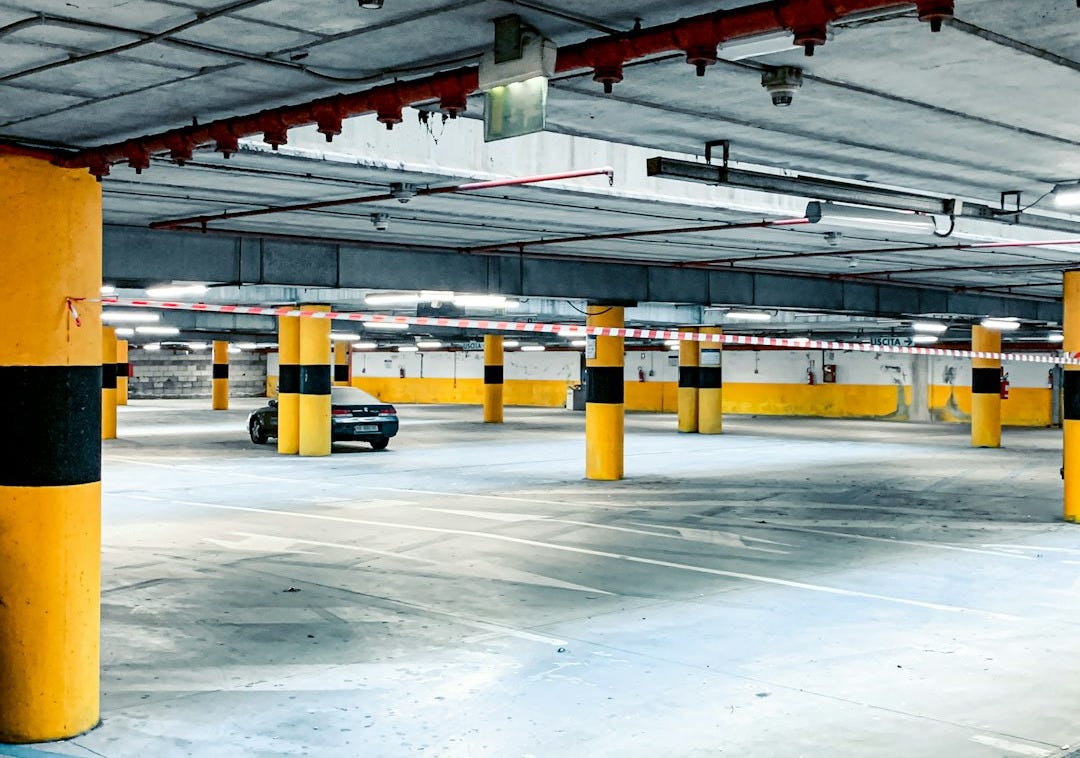
Will Briggs and Becky Jacobs at the Cap Times recently highlighted a budget priority item for the UW System: an expanded parking garage for UW Health American Family Children’s Hospital. It’s not the highest priority at #8, but it’s still worth $17,244,000.
My guess is most people glossed over this story. Yes, there’s parking, but the university is asking for more—that’s a good thing, right? In fact, the project lists “reduce[ing] traffic congestion and parking overflow into adjacent residential areas1, strengthening relationships between the university and the surrounding community” as part of its justification, in addition to the increased demand of pediatric healthcare facilities and improving patient survey scores. Easing the burden of mundane tasks like parking is helpful for families that might be experiencing the worst tragedy of their life. I can get behind that. But it’s critical for everyone to understand just how much it costs to store these private vehicles.
Updated Parking Costs
The first article I wrote for Counting Cranes was about an 800-page textbook covering “The High Cost of Free Parking.”
Parking Mandates: please end them

Madison has started to talk about parking mandates. Or maybe it’s just our Strong Towns Local Conversation. In any case, this is important to me because these rules do not make sense and they should not be on our books.
If you have read this textbook, the easier companion “Paved Paradise: How Parking Explains the World,” or articles from parking reformers, you have heard the estimated costs of parking stalls. The conventional wisdom was about $10,000 for surface lots, up to $30,000 for above-ground parking, and up to $50,000 for underground parking.
The UW System is giving us updated numbers. For a proposed 45,500-square-foot addition (vertically), the cost is estimated to be $12,890,000 in construction and a total budget estimate of $17,244,000.
I previously referenced the Victoria Transport Policy Institute to provide an estimated 300-400 square feet needed per parking spot. Using an average of 350 square feet per spot, we get the lower-bound estimate of the number of spaces the UW System is requesting: 130 stalls2.
This will cost the university $132,646 per parking stall.
It’s not even underground! If I wanted to be polite, I could limit the costs to “just construction.” That’s going to run $99,154 per stall.
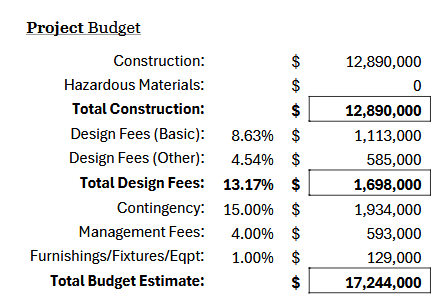
That overlooks that the project also acknowledges an ongoing annual cost of $734,828 for the Operating Budget, the majority being debt service. And this doesn’t factor in major repairs (which would be a future Capital Budget request). $99,000-$132,000 is a start, not the final cost.
People don’t know how expensive parking is
I like to run a thought experiment with friends. There exists a 3,000-stall underground parking facility built a decade ago. How much do you think this building cost?
The funniest response I’ve ever gotten is $750,000. The majority of responses are below $10,000,000. Only a few have hit $100,000,000, despite the actual cost being $150,000,000 (about $50,000/spot). Inflation has only gotten worse and we can now see that above-ground projects are beyond twice that figure.
The Cap Times did us a favor digging up this request from a Board Meeting back in August. But it’s too easy to overlook a “$17.2 million expansion project in its $2 billion capital budget request.” You do get a total stall estimate and expected gross square footage of the construction later on in the piece. But it takes someone3 to divide those numbers and throw out $99,000-$132,000 per stall into the discourse. If I could poll Cap Times readers and ask them how much they think the project costs, per stall, I doubt more than 5% would get reasonably close to these numbers (unless they did the math). And I think a large number of them would be outraged by the request. It’s a ton of money!
The next question would be…
Who’s paying for it?
The good thing is that technically, the UW-Madison Transportation Services (UWTS) is responsible for this payment. It is the “program” of the “program revenue supported borrowing” that makes up about 80% of the project funding. This is not a direct ask of Wisconsinites, Madisonians, or UW-Madison students.
UWTS is “operationally neutral,” meaning it charges fees for its services and the revenue pays for expenses. These hospital lots are typically paid for via validated parking, but other lots on campus have a fee. If the program has a structural deficit, rates have been raised in the past.
So I can’t “pin” this down as a bad project. If the university truly feels it is worth it to pay $100,000 or more per parking stall, and they want other drivers on campus to pay for it, it’s their prerogative to do that4.
I think it’s a good exercise in land use consequences. I find it interesting that preserving Shorewood Hills relationships is so vital to the university. One wonders if instead of complaining about cars parking in the neighborhood, the community decided to realize the value and use it to invest further in their neighborhoods. This is prime real estate (it’s right next to a premier university!), and yet it has an approximate housing density of 2 units/acre. That is less than half of Vilas (5 units/acre) and five times lower than Tenney-Lapham (10 units/acre). Residents probably feel like this traffic is undesirable and unwarranted, only because they’ve kept their land use artificially constricted while the rest of the area has grown.
I don’t have control over Shorewood Hills decisions, so I’ll leave you with updated parking costs. You can now tell your friends that it’ll cost someone over $100,000 to construct a parking stall. It’s up to you to determine if that’s a good use of money.
If you would like to review the budget request yourself, the items are found on pages 47-49 of the file below.

More from Counting Cranes
Madison Unanimously Fails Vision Zero

I pitched Isthmus on an opinion piece for the Regent Street vote. We lost the vote, but it’s still important for people to know what Common Council voted on and why. As we move further away from the decision, we lose context. I still stand by my work so I’m posting it here.
Getting to a Land Value Tax in Wisconsin

I previously wrote about my desire to implement a land value tax (LVT) in Madison. I discussed several vacant or underused lots near Downtown that I think would see rapid development if they were appropriately assessed and taxed.
Shorewood Hills specifically
The system says this budget request is for 130-250 new stalls. I think the hope is people will think this is leaning towards 250 spaces. Realistically, this is the lowest estimate they will get. If they want more than 130 stalls, they will have to pony up.
Observant parking nerds
Technically, if the parking revenues could not cover the new recurring obligations, it would then fall onto the university. That would have direct financial impact on residents. But for now we can assume that they will increase parking rates before asking for debt forgiveness.