


Former governor Phil Murphy of New Jersey signed some parting legislation a few days before his term ended that included a peculiar e-bike bill. This bill has bike advocates asking a lot of questions (and expressing a lot of frustration). This caught my attention, but what really raised my blood pressure was seeing Will Briggs have a feature story about e-bike, scooter, and e-moto rules in Wisconsin1. From the article I can see that the Wisconsin Bike Fed and other groups are already working towards avoiding a disaster like New Jersey and I hope we can have sensible rules to handle the reasonable complaints from the rise in e-bikes.
What New Jersey Got Wrong
Wisconsin recognizes the three-class system of e-bikes that exists in most of the United States.
The key characteristics of an e-bike are speed, how the motor is engaged, and battery size2. I own a Class 1 e-bike, which means that my electric motor will not assist me unless I’m pedaling. As soon as I hit about 19.6 mph, the motor cuts out, and moving any faster is under my own power. Class 2 has the same 20 mph cutoff point, but users power the motor via a throttle. Class 3 is like my bike but it supports up to 28 mph in pedal-assistance. “Classless” e-bikes are being redefined as “e-motos” to try and offer a distinction between the two types of transportation. There’s a big difference between bikes that move at 20 mph and “bikes” that are really just smaller motorcycles with speeds exceeding 40 mph.
Governor Evers signed a bill in 2019 that added the class system and allowed bicyclists to use e-bikes from classes 1-3 on mixed-use paths. This led to a boom in sales and an increase in ridership.
E-bikes across the country have seen a swell in sales. Shared bike-station trips went from 300,000 in 2010 to over 40,000,000 in 2022. In 2024, the U.S imported 400,000 more e-bikes (1,700,000) than sold electric vehicles (1,300,000). It is a cheaper form of transit (I bought my more expensive e-bike for $3,600) that provide users flexibility for last-mile trips and reduces strain or sweat by doing a lot of the work for you. There’s decent range (over 50 miles using ‘eco’ mode in my experience), you can maintain consistent speed, and cargo bikes or bakfiets can help handle a majority of trips like grocery runs.
Because e-bikes are affordable, convenient, and less strenuous, this surge has put previously unbothered traffic users into new situations. Walkers on bike paths may now see dozens of e-bikes go by them and drivers may come across more bikers on the road. These aren’t necessarily bad outcomes, but in situations where walkers are “buzzed” or collide with bikers, they walk away with bad tastes in their mouths. Drivers continually curse out bikers when they witness traffic violations or experience near misses (even if they are at fault). These mouths can proceed to yell, which gives an opening for New Jersey Democrats to pass new laws.
License and Registration, Please
New Jersey’s S4834 Bill does away with the multi-class system and places all non-human powered two-wheel vehicles under the same “motorized bicycle” restriction. It also requires all motorized bicycle users to:
Be over 16 years old to operate
Have a license (either driver’s license or a motorized bicycle license)
Have a registered motorized bicycle
Have an insurance policy
It will likely take some time before any data can percolate through on the effects of this bill. But I have two predictions:
This will increase the number of residents who passively break the law, without clear expectations on why they are breaking the law, that gives law enforcement opportunities to be punitive, inconsistently
Bike sales will decrease as shops explain that e-bikes require a whole lot of paperwork and payments that people probably feel are inappropriate
At this point car drivers might be saying “Finally! Bikes are like cars and it should have always been this way.” The issue is that cars and bikes are not the same thing.
Cars on average weigh 4,000 pounds and require just a bit of work to operate: you have to pass a written exam and driving test3 to legally operate the vehicle and operating the vehicle is as simple as lightly pressing the accelerator. Congrats, you are now a missile. One of the largest disagreements between car drivers and bikers is the “Idaho Stop” where bikes can legally treat stop signs as yield signs and red lights as stop signs. Car drivers believe bikes should operate by the same rules, despite not playing in the same field of physics, because everyone loves to go faster than slow and it’s not ‘fair’ if some people don’t have to stop.
The reason we have stop signs is because two cars colliding at 30 mph is going to cause a lot of damage. That system has over 300,000 joules of energy, whereas two bikes colliding at 15 mph will probably be closer to 8,000 joules4. That is over a 3,500% difference! It’s important that bikes stay aware of cars when roads need to be shared, but the vehicle that will cause damage is going to be the car.
It’s also much simpler for a vehicle to get up to speed, which is the largest factor in damage risk. With a few pounds of force a car can easily get up to speeds of 60 mph in several seconds. Bikes will hit a maximum speed, and it takes a lot of physical exertion over dozens of seconds to reach it.
This is why I don’t understand why e-bikes require a license. It’s a failure of the New Jersey legislature to split up e-bikes and e-motos. Vehicles going 40 mph should be licensed, and reasonable people can disagree if 28 mph should also be licensed. But 15 mph does not need to be licensed, and that is going to be the majority of e-bike cases. Parents might not know what they can buy, or if it will require insurance. Some neighbors or officers may assume a bike is electric and stop kids for no reason. We add additional burdens and costs onto the single most efficient method of transportation the planet has borne witness to, for no good reason.
Who’s the problem?
Representatives of UW Health and the Stoughton Police Department recently started a press blitz on the safety of e-bikes and e-scooters and “rais[ing] awareness about the risks of riding the bikes.” The articles cite statistics like an increase in crashes for e-bikes and e-scooters by 194% and 260%, with a 483% increase in emergency department visits.
The problem is that this is a newer technology, with unreliable reporting metrics. Anything that’s new and not effectively tracked will result in large changes in percentages. The true ED visit numbers they cite? Between April and May, there were 6 visits in 2025 increasing to 35 visits in 2026. There were 143 total crashes for all users in 2025.
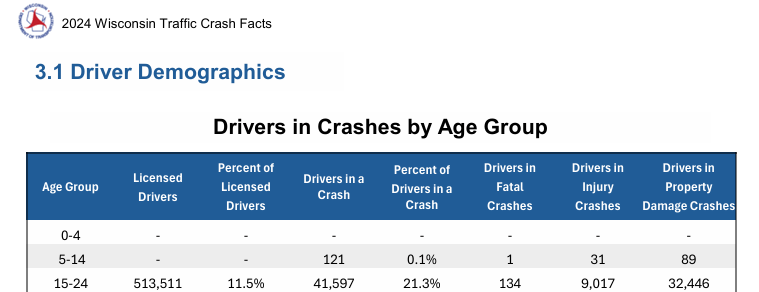
In 2024, drivers between the ages 5 and 24 were involved in 135 crashes that killed the driver, 9,000 crashes causing injury to the driver, and over 32,000 crashes causing damage.
I can understand healthcare professionals and officers wanting to chase the shiny object here with multi-hundred percent increases. It’s novel and the end result can be hard to not watch over and over:
This is what my bike looked like after my crash in 2023. I walked away with just a few scrapes.


And beyond the click-baity headlines, UW Health acknowledges that regulation would be difficult and the best course of action is education.
Ensure your child knows the rules of traffic
Check the device fits your child’s size and ability
Provide your child with the proper safety gear
Be sure they know where they can legally ride the device
But what worries me is people grasping onto the flashy trends and ignoring how vital bikes can be for children, compared to the real menace causing damage in our communities. I get defensive on this topic because I know kids can ride bikes safely; I biked to school from 5th grade through senior year of high school. An e-bike would have made the 20-minute bike ride to my friends’ houses, my first job, and my soccer practices 20% shorter (or allowed me to bike 20% further than I did).
Would I buy a child a Class 3 e-bike? No. I don’t even think I would buy a Class 1 bike for the 5th grade version of me. But the last thing we need in this age of children being less physically active is to put up barriers on a tool that is one of the most effective social activities for children.


4th of July parades on tricked-out bikes? School commutes to help wake up in the morning? Bikes to the park for games of soccer, basketball, and bike tag? Being able to explore a city before owning a driver’s license? Being able to see your friends across the city even if you don’t have a car? These were all possible because I could bike.
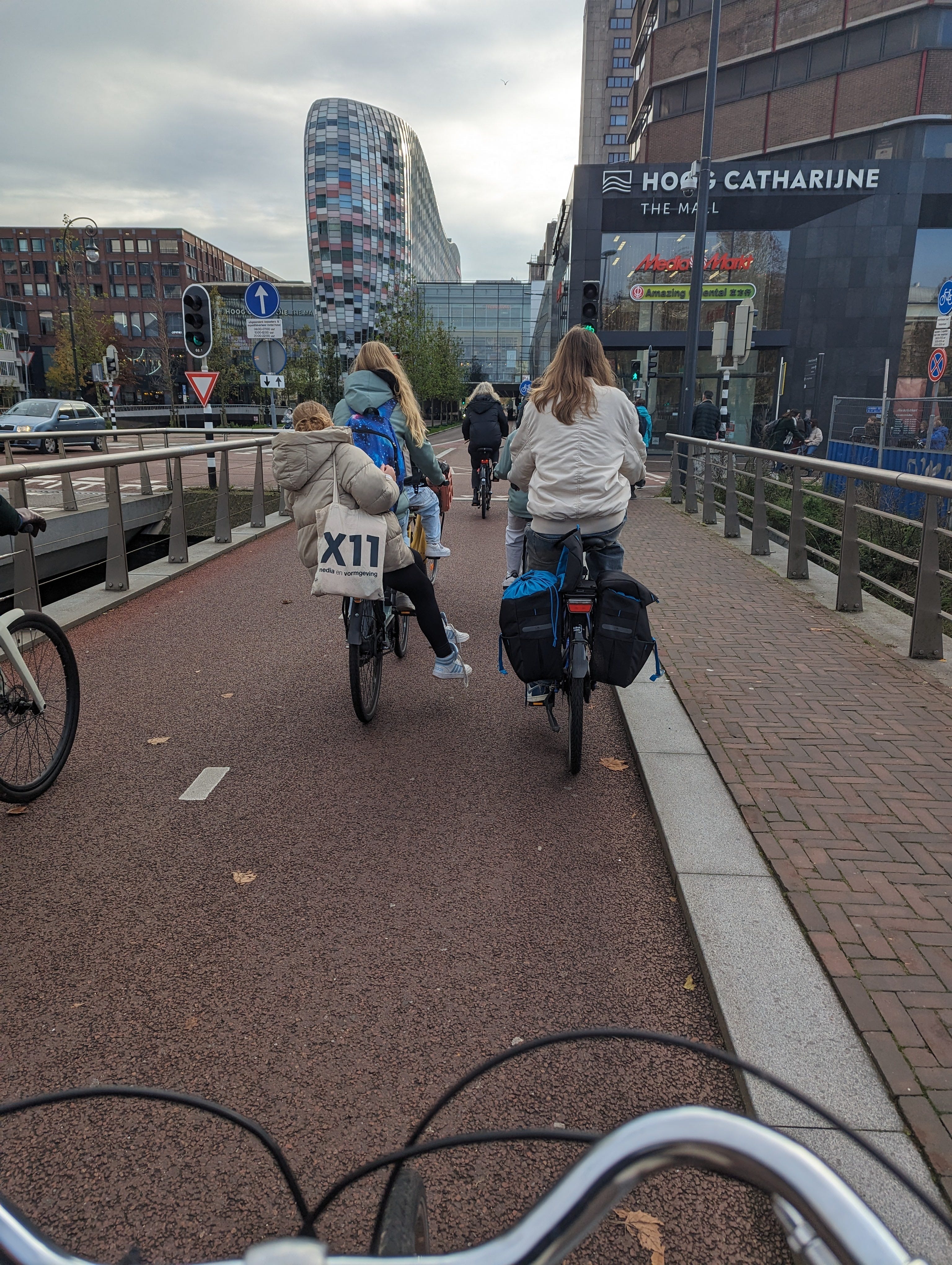
When doctors and officers say something, people listen. I know we can’t say this every time and treat it as news, but 35,000 people die every year from car crashes. It would mean more if UW Health didn’t just lobby Madison for a car-friendly design of Regent Street with no bike facilities. We should be advocating for streets that allow kids to bike safely to places they want to be, building neighborhoods that allow them to easily get to their friends, and making infrastructure that doesn’t require a ton of safety equipment:
Wisconsin state and municipalities should leave the New Jersey legislation alone. While making a dent in e-moto operations, it severs an artery of the biking community. It raises barriers for no reason on a cost-effective, healthy form of transportation. Instead, Wisconsin can focus on making productive bike networks and getting more people off of the dangerous roads.
More from Counting Cranes
Walk (and bike) your main streets

I’m posting more this month to raise awareness for the Strongest Town Contest, in which Madison is competing. Round 1 voting ends Friday at 9am central. Please consider voting for Madison!
What Madison can learn from Nijmegen

I had the pleasure of visiting the city of Nijmegen in the southeast Netherlands for a week in November 2023. As someone who was motivated by Not Just Bikes to start thinking about urban spaces and how people interact with cities, the Netherlands is the mecca for people looking for cultures that aren…
Will is really covering a lot of interesting topics at the Cap Times and I have to give him props for finding the stories and the newsroom for letting him cover them. He’s maintaining a high level of quality set by Allison Garfield for urbanist news in Madison.
Batteries up to 750 watts are in the 1-3 range, anything larger than 750 watts is considered classless.
COVID introduced a pilot program in Wisconsin for obtaining a waiver for driving tests. Parents could certify their child driver as competent without a physical driving exam, relying solely on written exams and 50 hours of supervised driving. 144,082 Wisconsin drivers did not take a physical driving test, because the program didn’t expire until January 1st, 2024. Teen drivers are notoriously some of the most prone to crashes, there’s potentially an incredible natural experiment here for some state staffer to review the efficacy of physical driving exams.
2 cars at 4,000 lbs going 30 mph is equal to 2 x (1/2)(1,800 kg)(13.4 m/s)^2. 2 bikes at 400 lbs going 15 mph is equal to 2 x (1/2)(180 kg)(6.7 m/s)^2 .