


Wisconsin is no stranger to a bracket tournament. I grew up during the incredible men’s basketball March Madness run from 2008-2017. Wisconsin made it to the Sweet Sixteen seven times and made back-to-back Final Four appearances in 2014 and 2015. We haven’t made it back since; a #5-#12 upset feels inevitable each year.
The women’s hockey team is a consistent championship performer (they won yesterday!), including this year’s class of seniors that have made it to the final game of the Frozen Four for their entire collegiate careers. Wisconsin vs. Ohio State also feels inevitable.
When I got a first look at the Strongest Town bracket, I felt confident about Madison’s chances. We could do well as long as we continued to remind people to vote.

But I was looking at two behemoths on the other side of the bracket. Chicago, which has over 1,000x the population of Cave City, AR, is still a concern for me just because of the large population in a popularity contest. All it takes is one viral moment to get tens of thousands of people to do the easy thing and vote.
I know our Local Conversation was wary of Spokane, WA too. They are nearly a housing-ready city with most of the reforms coming from a push in 2022. They have a form-based code for the Hamilton Street corridor. Top goals for this year include expanding a sales tax deferral for converting surface parking lots into affordable housing and allowing cities to implement “universal building exemptions” that would exempt “buildings and improvements” from taxes, moving the tax incidence to the land. There isn’t a “single-family only” zoning option but an “R1” zone that includes “Middle Housing” by right and a minimum lot size of 1,200 square feet:
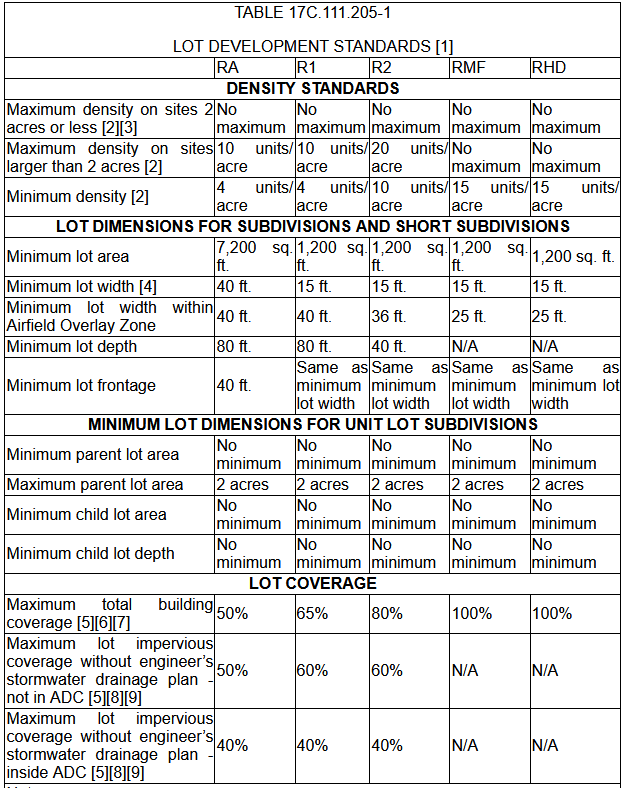
Madison (mostly) requires 5,000 square feet for its residential zones. The large exception is SR-C1, the most common zoning district in the City, which requires 6,000 square feet1. We made a lot of progress in 2025 with “Housing Forward” that contributed to our Strongest Town nomination. There’s no denying it’s a step in the right direction. But I hope City Staff can see other cities are implementing strategies to make more housing possible with success and reduce the concerns regarding maintaining neighborhood aesthetics and existing build character. Just because we required 25 foot setbacks in a neighborhood at some point in time doesn’t mean all buildings need to maintain that standard in perpetuity.
Madison wants to build

Last Wednesday brought a smile to my face for nearly the entire day. Our mayor, Satya Rhodes-Conway, announced along with 11 alder co-sponsors and pro-housing community groups three ordinance changes to incre…
To put it another way: if we somehow win this thing, I still hope some Spokane representatives are at the national gathering to help start discussions with Madisonians.
But Spokane lost! West Allis pulled through, along with Madison, Chicago, and Sheboygan, to round out a Midwest Final Four.
Midwest Magic
The easiest way to explain this is “taste voting” that exists in bracket tournaments like this one. I live in the Midwest, I may feel that I should vote for other Midwest cities2. There are thousands of voters in this popularity contest and if we all have a similar taste, that will be reflected in the end results.
The important thing to remember is that all nominations were vetted by the Strong Towns organization, so being here at all is a testament to working towards making these communities stronger (through fiscal, housing, or transportation means). I don’t have to make sense of who moves on and why, I just get to learn more about what they’ve accomplished.
Now put the voter hypothesis to the side for the rest of this article. Here’s my preferred hypothesis: the Midwest is an incubator for Strong Towns because cities were formed before the Growth Ponzi Scheme became an origin blueprint for cities.
That doesn’t mean any city can’t be a Strong Town; this contest shows that what matters is progressing forward towards better communities. Even if you are a zoning restricted, stroad-loving, punt-the-tax problem suburb town there’s still an opportunity for you to make a difference by removing parking mandates on your Main Street corridor.
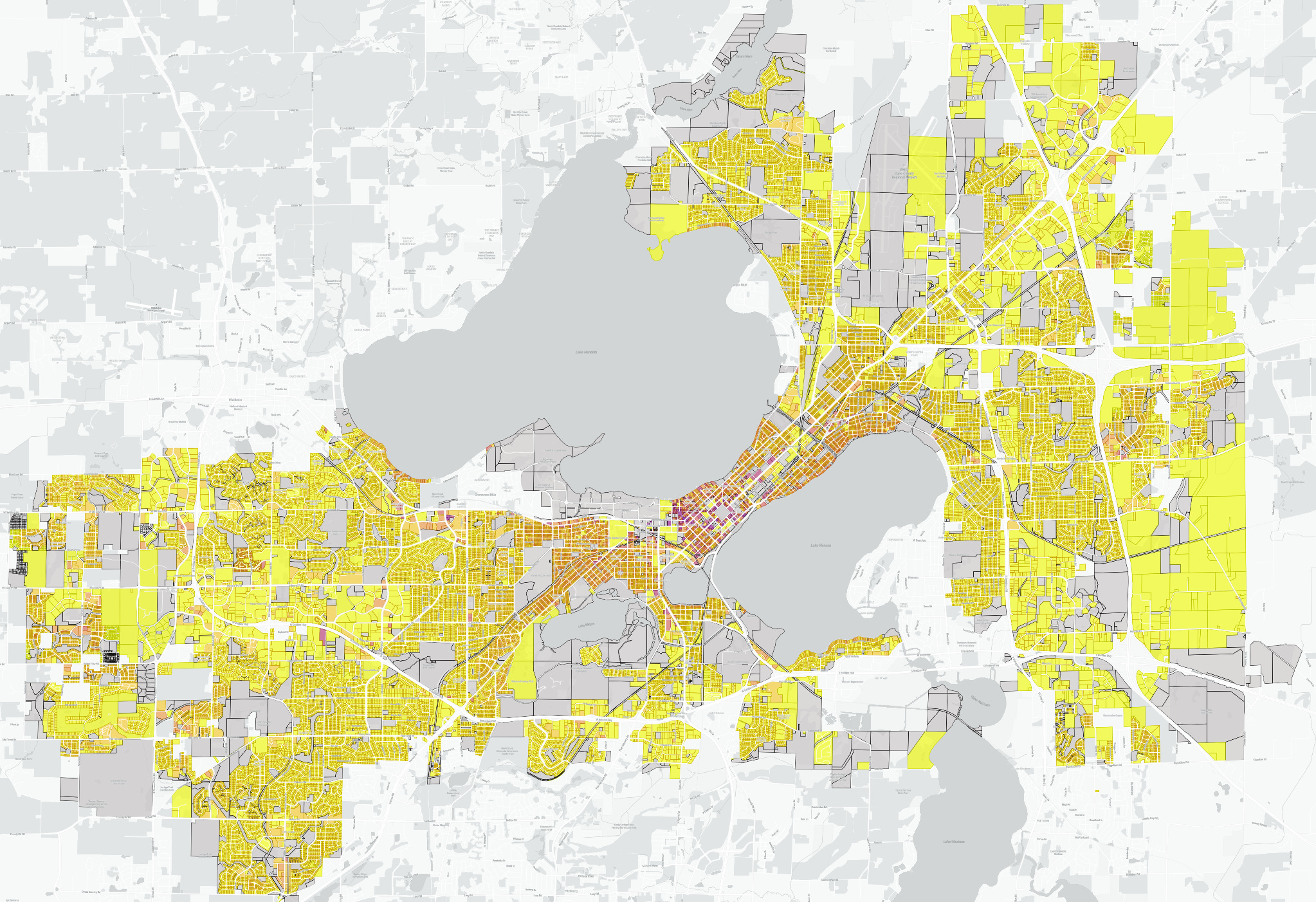
But the Midwest developed in a time before the expansion of the personal car. Madison in particular has a thriving Isthmus that’s foundation is built on a “street-car suburb” so strong that we still send the “C” bus down Jenifer Street instead of Williamson. The main streets in these communities blossomed before cars changed many American’s ways of living. Sure, we retrofit those streets to make them convenient for cars and expanded further using the newer car-oriented template. That’s entirely visible in the Madison property tax value per acre chart that I think should help inform every Madisonian’s opinion about housing, transportation, and municipal finances:
I also see it in sections of Monroe Street, an area with local businesses, schools, and many different housing forms, that can still feel like playing Frogger when trying to cross the street at specific intersections:
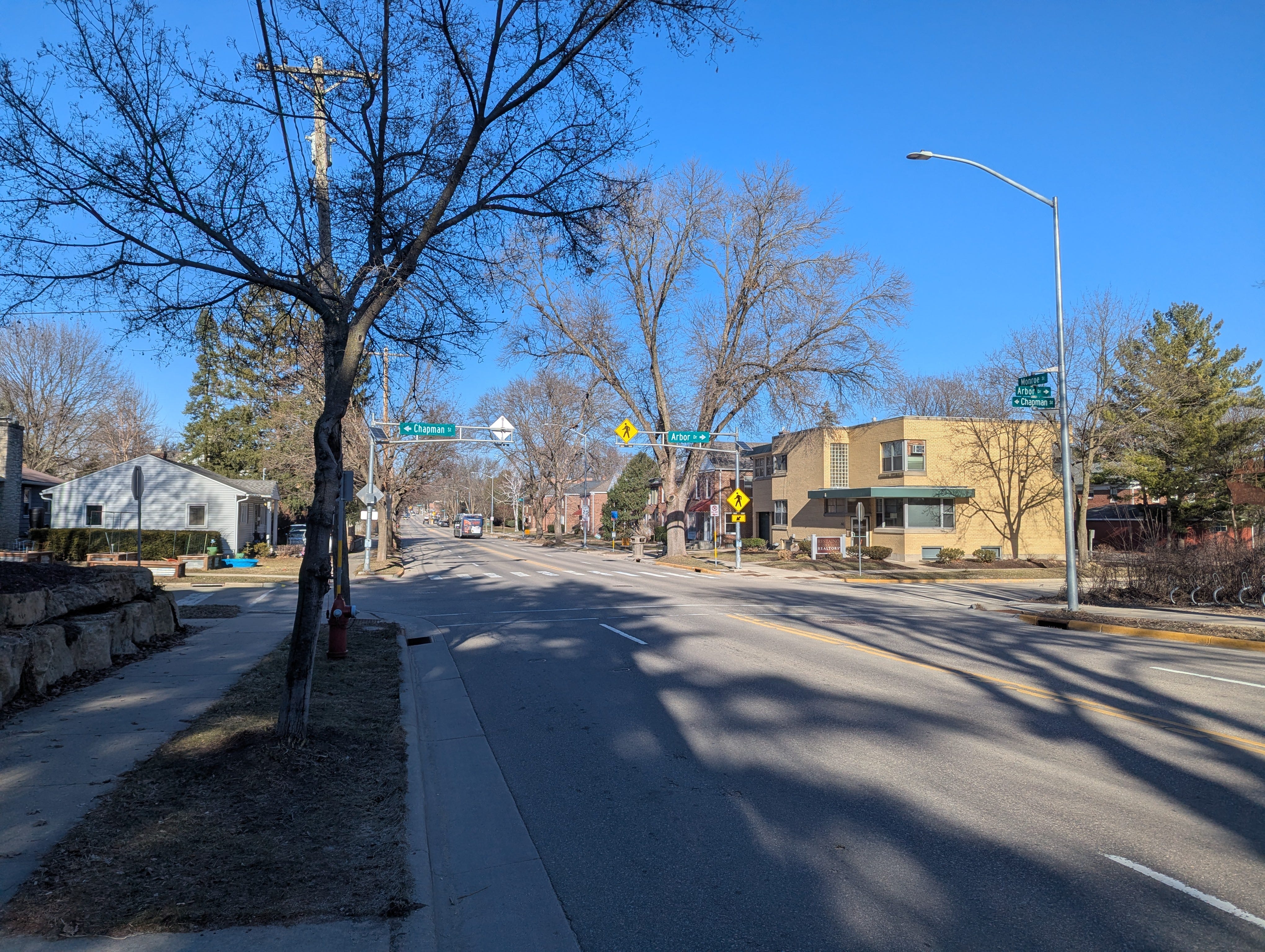
But because we had areas like Monroe Street before the car took off, we have existing, physical models to help realize how we can go back. These streets and neighborhoods weren’t built directly to accommodate driving, at least not initially. The “bones” are visible and all we have to do is take a walk down them to see what we could go back to.
We are the model
The Midwest is seeing population decline in most areas. Chicago is down nearly 900,000 people from its 1950’s population peak. Milwaukee is down nearly 150,000 people from its 1960’s peak (although the county has seen recent growth). Madison and Dane County are growing, and growing fast, but that is likely at the expense of other communities in Wisconsin.
The Sun Belt is not. Millions of people are migrating to Texas, Arizona, New Mexico, the Carolinas and the like. Innovations in A/C make these areas habitable year round while we get stuck with blizzards in March.
We’ve been around long enough that our previous investments are now coming up for maintenance. Land is limited in capacity; we can’t just expand to more farmland or desert. Because of population decline, we already experience a declining tax base. My generation may face the generation of defaults, where cities over-committed to infrastructure they could never maintain go bankrupt.
Here’s Madison’s financial picture as of the 2024 Annual Comprehensive Financial Report.


Our story is complicated. We face a structural deficit. Voters approved an expansion of our property tax levy (the state restricts property tax increases to “net new construction”, there’s no peg to inflation) in November 2024 alongside large increases in the school tax levy. The school levy finally made it onto bills and many people are uneasy3. Alders emailed constituents to make it clear the city’s part of the bill is considerably less and increasing by a smaller % than the school’s portion.
But you can see that Madison’s budget has been looking better as of 2019. It’s stabilizing, if not improving. There’s more work to be done here, but what this year’s Strongest Town Contest can help highlight is that eventually, most cities are going to have to get on board.
“On board” means building your streets to foster prosperity. Putting homes and businesses together so people invest in their community. Ensuring that places are safe from reckless drivers and that no person, but especially a second person, has to die on your street. Not wasting “free” space for private vehicles or other entities that could instead make a place more interesting. Nothing is free, everything is an asset, and cities should ensure that they are getting value (thriving neighborhoods, tax revenue, cherished institutions, etc.) from their infrastructure. Be skeptical when infrastructure comes up for maintenance; “is this working the way we want it to be?” The Midwest cities are going to take the first crack at it and everyone else can hopefully learn from our mistakes.
There aren’t many people who are truly willing to pay for the luxury of isolating homes from the places people want to be. The deferred maintenance has a cost and it would be best for people to realize this is happening now rather than decades down the line and finding someone to hand the bag off to. Eventually these debts will be due. I don’t want to be left holding the bag.
“They always get you” is how I approach taxes in my life. There’s no way around it; some kind of tax (property, income, sales, wheel, etc.) will exist to ensure the government can sustain itself. There are costs associated with the Growth Ponzi Scheme. Not everyone will get a free ride.
But Madison, and the remaining Midwest communities we are going up against, can hopefully be the vanguard for incremental changes leading to exponential benefits. Our community showed that a local business hub doesn’t need to prioritize pushing vehicles through a choke point at the expense of safety. This led to potential lane removals for a different local business hub, which might lead to even more lane removals, until the default form is a street built for people. These hubs generate millions in tax revenue for the City and they could generate even more with these reforms.
We pushed for small changes to ADUs, which led to larger changes to specific kinds of homes, which led to larger changes allowing duplexes by right everywhere a single family home can be built. It’s incredible how four months can change the outlook of we are never going to get duplexes to wow, we voted for duplexes unanimously, with no public comment against! These are seeds we are planting that will take years to blossom, but they are so valuable to start planting now rather than five years from now.
We are never going to get everything in one fell swoop. But serious, committed work from the bottom-up is leading to larger and larger positive knock-on effects. This contest helps identify those small changes. My hope is that the Midwest can show how any community can take these actions now and get the ball rolling.
Madison is the Strongest Town

Strong Towns holds a contest each year to determine a town that best exemplifies the Strong Towns approach to city building. I think Madison should get your vote.
Not uncommon, but my home would be illegal if I were located in SR-C1. I also grew up in an illegal home because the minimum lot size requirement was 7,000 square feet.
For the record I did vote for Spokane even if they made for a harder match-up later on.
The unfortunate situation for MMSD residents is it’s only going to get worse, the increases don’t stop for several years.